Event 1
Richard Black's death and the inheritance of Faith Plantation
Richard Black’s death sets in motion the transfer of [Faith Plantation](entity:location-recall-location-faith-plantation-022a324e99e0) to [Erasmus Wilde](entity:character-recall-character-erasmus-wilde-686fae23fb63), a change in ownership that turns Washington Black’s childhood fear of an estate sale into a harsher reality. The event is remembered not as a private family transition but through its consequences for the enslaved people: their labor remains a source of wealth, while the new regime intensifies punishment and control.
## Death and succession
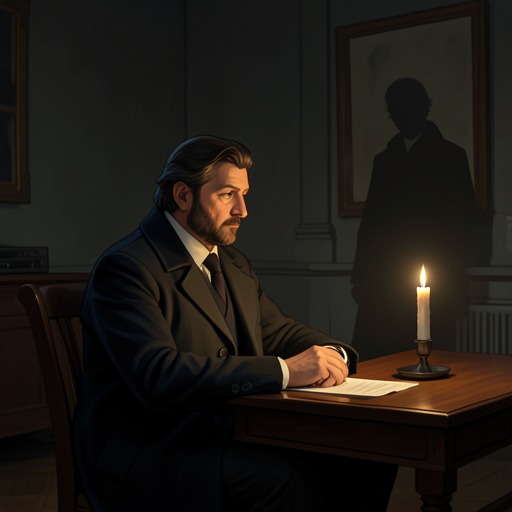
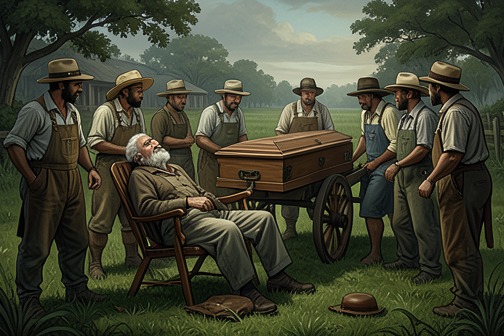
Richard Black is described as very old and largely distant from the people working his estate. Washington recalls seeing him asleep in a chair on the lawn, while the workers, expecting an estate sale after his death, mourned for themselves rather than for their master. Washington and [Big Kit](entity:character-recall-character-big-kit-7bc19d4cb80d) watched as overseers carried the coffin from the Great House and placed it in a wagon. In his later account, he names this moment as the beginning of a pattern in which the dead seemed to go free while the living remained bound to the plantation.
Eighteen weeks later, Richard’s nephew arrived from [Bridge Town](entity:location-recall-location-bridge-town-770b90291db9) with a procession of carriages. The estate had not been sold off, a development the workers initially took as a mercy. The arrival instead marked the transfer of authority within the family. Richard’s estates, including Faith Plantation, passed to his nephew Erasmus Wilde and his brothers. Christopher Wilde later explains that [Erasmus](entity:character-recall-character-erasmus-1b3a48b98972) already managed family properties while their father spent long periods away on scientific research, and that Richard’s inheritance added [Faith](entity:location-recall-location-faith-a5239fbf2174) to the estates Erasmus was responsible for.
## New management and plantation violence
Erasmus’s succession brought a sharp change in the people enforcing plantation discipline. In his second week, he dismissed the old overseers and replaced them with rough men drawn from the docks, including former soldiers and enslavers. Washington remembers the new regime through the punishments and killings imposed on workers. These acts were not incidental to the inheritance: they established the conditions under which the estate’s labor would be controlled and its productivity maintained.
The violence also exposed the plantation’s calculation of people as usable labor. When Christopher proposed that enslaved workers help construct his experimental craft, Erasmus objected that he could not lose fifteen workers and cited the demands of the field schedule. His response places the family’s scientific ambitions alongside the estate’s dependence on coerced labor: the work might be assigned, but only within limits set by the value of the workforce to the plantation.
## Wealth and the family estate
Christopher describes the inheritance as a reversal in the family’s fortunes. The Wildes had been financially declining, in part because of their father’s costly scientific pursuits; Richard’s estate brought wealth back to the family. Erasmus was expected to spend most of his time in the West Indies, making periodic journeys to [England](entity:location-recall-location-england-b153c1f368ea), because Faith was the property that supplied money to the family’s other estates. The inheritance therefore made the plantation central not only to Erasmus’s responsibilities but also to the wider family economy.
That economic function persisted beyond the period of outright enslavement. When Washington later returned to ask what had happened to the people at Faith, Mrs. Wilde said the plantation had been sold and maintained that the former enslaved people had become apprentices and workers, receiving payment and lodging. Her account contrasts with Washington’s concern for people such as Big Kit and [Gaius](entity:character-recall-character-gaius-79dc493630f3), and with the records he consults: a change in legal status does not erase the history or consequences of the inherited plantation system.
## Memory, records, and aftermath
The episode reaches Washington through several forms of retrospective evidence. He begins by acknowledging uncertainty about his own origins and then restarts his narrative explicitly for the record. Later, Christopher shows him a written catalogue documenting abuses at Faith, including an account of Big Kit’s condition. The catalogue makes the plantation’s suffering legible as evidence intended to support abolition, though it cannot restore the lives it records.
Washington’s search through the plantation records gives the inheritance a personal ending. In a log of apprentices, he finds Big Kit’s death date, recorded among names and dates in a form that makes people appear like entries in an inventory. He does not find her under either the name Nawi, which she had told him was her true name, or the name assigned to her on arrival in the Caribbean; he eventually locates her entry and understands that she is dead. The succession that began with Richard’s funeral thus extends, in Washington’s account, from property passing between owners to the archival trace of those who lived and died under its authority.
Event 2
Erasmus Wilde takes over Faith Plantation
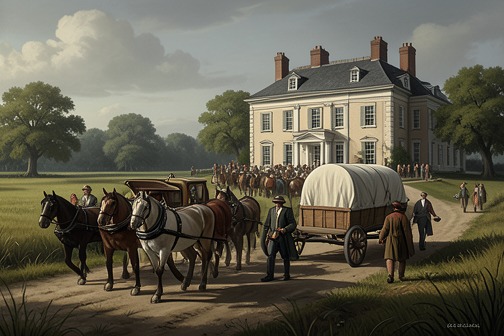
[Erasmus Wilde](entity:character-recall-character-erasmus-wilde-686fae23fb63)’s takeover of [Faith Plantation](entity:location-recall-location-faith-plantation-022a324e99e0) begins a new period of intensified violence in Washington Black’s life and becomes a defining episode in his later effort to recover the past. Recalled by Washington as part of an account he explicitly restarts “for the record,” the arrival first appears as a change of ownership and quickly reveals itself as a change in the conditions of life on the estate. Its consequences reach beyond the plantation: years later, Washington finds the people and events of [Faith](entity:location-recall-location-faith-a5239fbf2174) represented in documentary records, where individual lives risk being reduced to names, dates, and labor categories.
## Arrival and transfer of power
Eighteen weeks after the estate’s previous upheaval, a caravan came from the harbor at [Bridge Town](entity:location-recall-location-bridge-town-770b90291db9). Washington remembers being with [Big Kit](entity:character-recall-character-big-kit-7bc19d4cb80d) at the edge of the cane, where he usually stayed close to her. At the rear of the procession was a large object covered with canvas and secured to a flatbed wagon; its purpose was not apparent to him. The arrival was watched from the Great House as well as the fields, making the transfer visible across the different spaces of plantation life.
Christopher Wilde emerged first and inspected the covered object, walking around it and examining its ropes and canvas. [Erasmus](entity:character-recall-character-erasmus-1b3a48b98972) followed, and Washington recognized him at once as the new master. His account dwells on the contrast between the two men’s entrances: Christopher’s attention turns to the unfamiliar apparatus, while Erasmus’s presence makes the hierarchy governing the estate unmistakable. Washington recalls that Big Kit shuddered beside him. In retrospect, he believes this was when she calmly resolved that she and Washington should die together, a response shaped by her understanding of what the new master’s arrival might mean.
## A harsher regime on the plantation
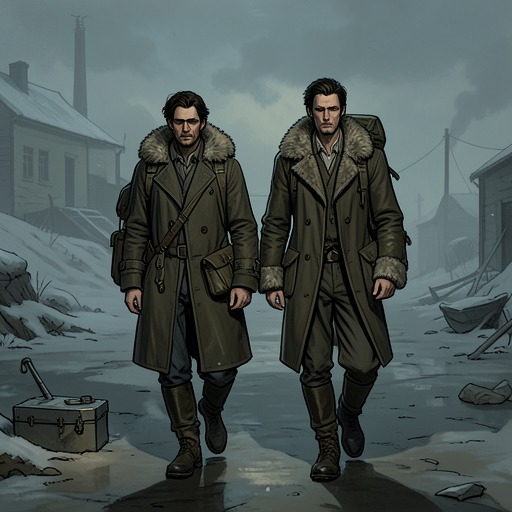
By the second week, Erasmus had dismissed the old overseers and brought in rough men from the docks. The replacements included former soldiers and former enslavers, as well as poor island men; under their supervision, the plantation’s discipline became more brutal. Washington remembers people being injured and punished, and describes the killing of James after James tried to escape. The killing was made exemplary: afterward, the workers were made to pass the remains and were branded again. Other deaths followed, and Washington, still a boy, cried at night.
The response of Big Kit contrasted with Washington’s childhood terror. As deaths accumulated, she met them with grim satisfaction rather than fear. She understood death through a belief that the dead could be reborn in their homelands, whole and free. In Washington’s later interpretation, Erasmus’s arrival had helped turn this belief into a possible way out of the new plantation regime. Her decision to include Washington in her intended death joined care for him to a stark refusal to accept the master’s power over their lives.
Erasmus’s authority also shaped decisions beyond the immediate administration of the estate. When Christopher sought to use enslaved workers for his undertaking, Erasmus refused to risk losing fifteen of them and cited the demands of field labor. The exchange makes the plantation’s priorities explicit: workers were counted as indispensable labor, and their availability was governed by the master’s calculations rather than by their own wishes. Christopher’s project could proceed only within the limits imposed by his brother’s control of the people on the estate.
## Memory, testimony, and the record
Washington’s narration makes clear that this history is reconstructed from an adult perspective. He distinguishes between what he was told about his birth and competing accounts of where it took place, then declares that his narrative has no true beginning and must be begun again “for the record.” The recollection of Erasmus’s arrival is therefore more than a scene of succession: it is part of Washington’s attempt to set down a history whose earliest details remain uncertain and whose violence was lived before he could understand it.
Christopher later shows Washington a document titled *[Catalogue of the Injustices and Cruelties Borne Upon the Persons and Minds of the Enslaved Negroes on a Barbadoes Plantation in the West Indies](entity:object-recall-object-catalogue-of-the-injus-6b15cba2d25c)*. He explains that he has been recording abuses at Faith for an antislavery effort, intending the reports to reach an influential figure in Parliament. The catalogue includes Big Kit’s condition. This record offers evidence of what the plantation’s authority concealed or normalized, but it does not erase the difference between documenting suffering and having endured it. Washington’s response is complicated by the discovery that Christopher has recorded Big Kit and by his distress at seeing her mistreated.
Years later, Washington and [Tanna](entity:character-recall-character-tanna-7e2f4be68e90) consult Faith’s records. The repository remains involved in opposing slavery even after emancipation in the Indies, and its staff warns that slavery persists elsewhere, particularly in America. Among the materials Washington finds an old newspaper scrapbook containing notices about enslaved people and plantation life, including the reward notice issued for his capture. A separate apprenticeship log lists people who continued working on the plantation after emancipation and records their deaths. Washington finds Big Kit’s death date there, though neither the name Nawi nor the later name given to her appears as he searches. The plain administrative entry brings the consequences of plantation rule into the present: the record preserves a fact of her death while exposing how little room its format allows for her life.
## Consequences and significance
The takeover establishes the conditions behind Washington’s early understanding of freedom, fear, and death. Erasmus’s power is not confined to the moment he becomes master; it operates through overseers, punishment, labor demands, and the authority to determine how enslaved people are treated. The refusal to spare fifteen workers makes that system visible in a single practical decision, while the later apprenticeship records show that legal change did not simply remove Faith’s laboring population from the estate’s history.
The episode also gives the novel’s act of remembering a political dimension. Washington moves between childhood observation, adult interpretation, and written evidence: the arrival he witnessed, the catalogue Christopher compiled, and the records that later disclose Big Kit’s death. Each form of knowledge has limits. His early self could see the change in power but could not fully explain it; the catalogue can testify to cruelty but cannot restore the people it names; the ledger can record a death while flattening the life behind it. By returning to Faith through these different records, Washington makes the takeover not just a private memory but a history of enslavement whose consequences persist in how people are counted, remembered, and mourned.
Event 3
William's public beheading after his suicide
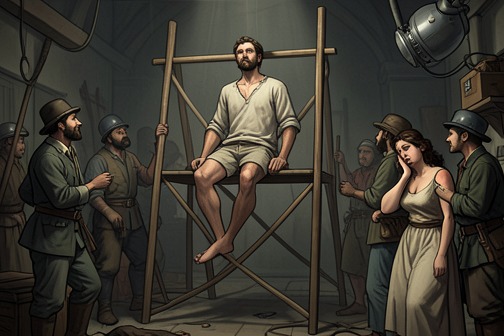
William’s public beheading after his suicide is [Erasmus Wilde](entity:character-recall-character-erasmus-wilde-686fae23fb63)’s calculated response to enslaved people who believe that death will return them to freedom in their ancestral homelands. By ordering William’s body displayed before the assembled plantation workers and declaring that a person could not be reborn without his head, [Erasmus](entity:character-recall-character-erasmus-1b3a48b98972) tries to make even death serve the logic of ownership. Washington Black witnesses the spectacle as a child, and its immediate human consequence is visible in [Big Kit](entity:character-recall-character-big-kit-7bc19d4cb80d)’s despair.
## Background and Stakes
William’s death follows suicides by two older Saltwaters, Cosimo and Adam, who are described as believers in reincarnation in their ancestral lands. William, by contrast, was born on [Faith Plantation](entity:location-recall-location-faith-plantation-022a324e99e0). His suicide extends a pattern of deaths among people living under the plantation’s new master, but it prompts Erasmus to intervene publicly rather than treat the death as an isolated loss.
The scene takes place after Erasmus has dismissed the old overseers and brought in new men. The plantation has already become more violent: workers are maimed and punished, and James is killed after trying to escape. Washington’s recollection places William’s death within this escalation. The threat is not only that workers may die, but that they may understand death as a way out of enslavement.
## The Public Display
Erasmus gathers the workers at the edge of the cane and approaches in white clothes, accompanied by an overseer pushing a wheelbarrow. William’s body is brought out before the assembled group. The public setting matters: the punishment is directed at the living as much as it concerns the dead, and Washington sees that Big Kit, standing above him, is frightened.
Erasmus describes William’s suicide as theft, arguing that William was his slave and had therefore stolen from him by taking his own life. He acknowledges the workers’ belief that death may return them to their homelands, then orders the overseer to remove William’s head and place it on a wooden post. The act converts Erasmus’s claim into a threat made visible to everyone present.
Erasmus’s warning is explicit: without a head, he says, no one can be reborn; he will do the same to every person who dies by suicide, and tells the workers to let their deaths come naturally. The language presents a denial of their belief as a rule imposed by the master. Rather than recognize a person’s power over his own life, Erasmus asserts that the enslaved remain his property even in death.
## Witness and Consequences
Washington watches the demonstration and then looks to Big Kit. Her response is not the fierce satisfaction he has associated with her in the wake of earlier killings. He sees despair in her face. That change gives the event its intimate consequence: Erasmus’s threat reaches beyond its intended audience of plantation workers and strikes at the hope Big Kit has held out to Washington.
Earlier, Big Kit had spoken of returning to [Dahomey](entity:location-recall-location-dahomey-397cc35d5cf5) and described a plan that depended on the right moon and the right words. Washington had wanted to accompany her there, free. The public display gives the threat a direct bearing on that shared hope, although the account does not establish precisely how Big Kit understands or changes her plans afterward. It does establish that, in this moment, Washington recognizes her despair.
## Recollection and Significance
The event is narrated by Washington as part of his remembered childhood on Faith Plantation. The larger narrative makes his act of telling a form of witness: he begins again for the record, distinguishing what he was told about his origins from what he remembers and later learns. William’s display remains one of the scenes through which that record shows how enslaved people were treated not as owners of their own lives, but as property subject to punishment even after death.
The book later sets personal recollection beside written records. [Titch](entity:character-recall-character-titch-aeced6aa1952)’s report of abuses is intended to document cruelties for abolitionist purposes, while plantation records preserve names and death dates in a system that can reduce lives to entries. Against both kinds of record, Washington’s account restores the human consequence of this particular spectacle: a child witnesses a public threat, and the woman who had offered him a vision of freedom appears overcome by despair.
Event 4
Sir James Wilde dies in the Arctic
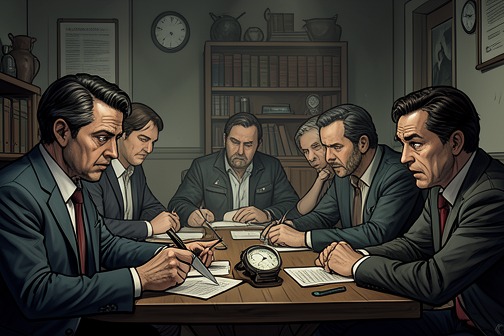
[Sir James Wilde](entity:character-recall-character-sir-james-wilde-a2105c79d7f5) dies at an Arctic outpost, but the novel first makes his death known through a report delivered far from the Arctic. [Philip](entity:character-recall-character-philip-f89be33d583c) tells Christopher Wilde and [Erasmus Wilde](entity:character-recall-character-erasmus-wilde-686fae23fb63) that their father has died in an accident, then explains that a letter from their mother contains further details. The announcement turns a distant death into an immediate family and property crisis: [Erasmus](entity:character-recall-character-erasmus-1b3a48b98972) is expected to return to [England](entity:location-recall-location-england-b153c1f368ea), and Christopher is proposed as the person who might manage [Faith Plantation](entity:location-recall-location-faith-plantation-022a324e99e0) in his absence.
## The report at dinner
Philip reveals the news during a meal, looking down at his dinner knife before telling Christopher that their father has passed away. When Christopher asks for clarification, Philip confirms that Sir James is dead and identifies the location as his Arctic outpost. He says he does not know the particulars of the accident. The scene therefore establishes the death without reconstructing it: the event reaches the reader as a piece of troubling news, not as an observed final moment.
Christopher’s response is one of stunned incomprehension. He blinks rapidly, searches for words, and asks again whether Philip means that their father is deceased. Philip answers with sympathy and says that he has brought a letter from [Granbourne](entity:location-recall-location-granbourne-b0c4f3a26ab8), written by their mother, which he will fetch after the last course. The letter is presented as the source of fuller information, but its contents are not disclosed in the announcement scene. The surrounding quiet, broken only by a servant cleaning the sideboard, holds the family’s reaction in suspension while the practical implications begin to emerge.
## Family loss and inheritance
The news affects both brothers, though the scene gives special attention to Erasmus’s position as the master of Faith Plantation. Christopher looks toward him, and Erasmus’s face, already altered by illness, turns pale. Their shared silence registers the loss before either brother can respond at length. At the same time, Sir James’s death changes what the family expects them to do: Philip says that Erasmus will need to leave [Faith](entity:location-recall-location-faith-a5239fbf2174) for [Hampshire](entity:location-recall-location-hampshire-4cc13adc155e) to settle his father’s affairs and take charge of Granbourne for a period that may last a year or two.
That proposed departure is not simply a personal journey. Philip says that Erasmus’s passage has already been booked and that their mother expects him to return with Philip. When Erasmus asks what will happen to Faith in his absence, Philip suggests that Christopher could run the plantation for two or three years. He presents the arrangement as their mother’s idea and expects Erasmus to sort out any resulting disorder when he eventually returns. Thus the death sets inheritance and estate management in motion, while placing Christopher in a position of responsibility he has not yet accepted.
## The unsettled question of Faith
The proposed handover brings the brothers’ competing circumstances into focus. Erasmus initially seems to weigh the prospect of returning to England as a reprieve, but he also asks calmly what is to become of Faith. Philip’s account makes the plantation’s future contingent on Christopher’s ability to manage it profitably, with Erasmus expected to resume control later. The death therefore creates a temporary reallocation of authority rather than a settled transfer: the family’s plans depend on a letter whose details have not yet been read aloud and on Christopher’s possible stewardship.
The wider consequences of the estate system are visible elsewhere in the novel. Under the new master at Faith, overseers are replaced and severe punishments become part of plantation life; a later conversation about the work required to keep the estate running treats the loss of fifteen enslaved workers as an obstacle to the proposed plan. These details place the family’s calculations within a structure that measures plantation management through control of labor. Sir James’s death initiates a change in who is expected to administer the estate, but it does not, by itself, end that system.
## Distance, uncertainty, and aftermath
The Arctic remains distant and largely undescribed in the report. Philip identifies an accident at Sir James’s outpost but cannot explain how it happened, and the letter that might supply particulars is deferred until after dinner. The distinction between the confirmed fact of death and the unknown circumstances matters: the family must begin making decisions before the scene provides an account of the accident itself. The event’s narrative force comes from this imbalance between certainty about the loss and uncertainty about its details.
Later, when Christopher and Washington Black reach [Norfolk](entity:location-recall-location-ead851996a91), the Kinast brothers allow them to leave their ship discreetly and ask that its name and their own not be mentioned. Christopher warns Washington to place little trust in strangers, saying that mercy may be revoked. Still later, Washington learns that Faith has been sold and asks what became of the people who had lived there. Mrs. Wilde describes them as former slaves who had become apprentices and workers, insisting that they were paid and housed; Washington’s concern for [Big Kit](entity:character-recall-character-big-kit-7bc19d4cb80d) and [Gaius](entity:character-recall-character-gaius-79dc493630f3) makes the consequences of estate ownership personal. These later developments broaden the significance of the family’s property decisions, but they do not provide further facts about Sir James’s accident. His death remains a reported turning point: it redirects his sons, unsettles the management of Faith, and leaves the precise circumstances of his final days outside the account presented here.
Event 5
Washington Black reunites with Big Kit
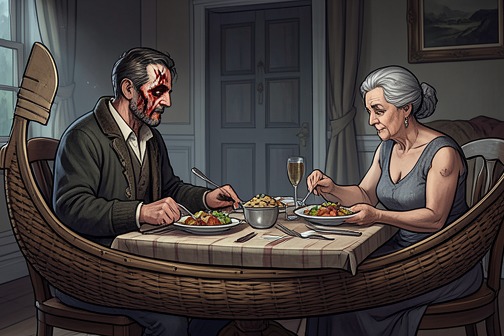
[Washington Black reunites with Big Kit](entity:event-recall-event-washington-black-big-ki-a06a8b485a08) at [Faith Plantation](entity:location-recall-location-faith-plantation-022a324e99e0) during a dinner hosted by [Erasmus Wilde](entity:character-recall-character-erasmus-wilde-686fae23fb63). The recognition is intimate but constrained: Washington sees the woman who once protected him only after first viewing her as an unfamiliar, injured enslaved worker, and the masters’ authority prevents them from speaking. The scene brings their former bond into the present while making visible the years of separation and the violence that has altered both their lives.
## The encounter at dinner
Washington accompanies [Titch](entity:character-recall-character-titch-aeced6aa1952) to dine with [Erasmus](entity:character-recall-character-erasmus-1b3a48b98972), who has recovered from a prolonged fever. Still visibly burned and disfigured, Washington has been told not to serve or strain himself. Other enslaved people attend the table instead, including an older woman and a small boy. Their presence recalls Washington’s earlier service in that room with [Big Kit](entity:character-recall-character-big-kit-7bc19d4cb80d), but at first he does not recognize the older woman as her.
The woman is physically changed and moves with difficulty; she has lost part of a shoulder. Washington notices that she takes the heavier dishes and leaves the boy easier work, a pattern of practical care that immediately recalls how Big Kit once tried to spare him. She briefly smiles at him when the masters are not looking. That fleeting gesture passes without recognition: Washington turns away, trying not to remember his former protector.
## Recognition and remembered care
The reunion occurs when Titch leaves the room. Watching him go, Washington sees the older woman turn and meets her eyes. The recognition lands as pain and confusion before he understands its cause: the woman is Big Kit. The revelation reorders the scene around him. The careful treatment of the boy, the quick smile, and the familiar quality of her gaze are no longer incidental observations but signs of a bond Washington had not realized was still present before him.
His response draws on memories of Big Kit’s importance during his earlier life. When he first lived with Titch, her iron nail had helped keep him from despair. After the gas explosion, waking in darkness, he believed she was beside his bed with a hand on his brow. He had continued to pray for her deliverance and to imagine her living beyond [Faith](entity:location-recall-location-faith-a5239fbf2174)’s fields. The dinner brings those remembered acts of protection face to face with the reality of her return to plantation labor.
## Change, separation, and the child
Washington sees how much time and hardship have altered Big Kit: she is thinner, her hair has silvered at the temples, and her injuries make her seem decades older to him. He also recognizes that he has changed. The reunion therefore refuses a simple return to their earlier relationship; each encounters someone reshaped by years apart, and Washington feels the distance as a truth about both of them.
Big Kit’s attentiveness to the boy gives Washington a further glimpse of her life. She watches his posture and manners and shields him from the more difficult work, as she had once tried to protect Washington. He reads this care as fierce love, and the sight produces an unexpected ache. The scene suggests a continuity in Big Kit’s protective devotion without establishing the boy’s identity or explaining his relationship to her.
## A reunion constrained by power
Although Washington tries to catch Big Kit’s eye, she is ordered to leave before they can speak. She retrieves a fork from the sideboard and departs with the boy following. Washington watches her go, desperate, while Erasmus’s authority remains physically present: shortly afterward, the master grips Washington by the collarbone. The reunion thus offers recognition without private conversation, embrace, or escape. Their relationship becomes legible through remembered care and small gestures, but the plantation’s hierarchy still dictates who may remain in the room and who must leave.
The contrast between the dinner table and the enslaved workers serving it also frames the personal encounter within a continuing system of domination. The masters’ conversation proceeds as the workers move cautiously around them. Big Kit’s attentive kindness toward the child is visible within that arrangement, but it does not remove the danger or restore the life Washington once imagined for her. The scene’s force comes from that unresolved conjunction: he finds the person he had mourned and hoped to free, yet recognition cannot undo her circumstances or the years that separated them.
Event 6
Philip Wilde kills himself in front of Wash
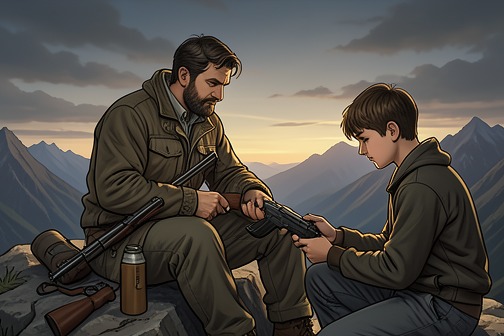
[Philip Wilde](entity:character-recall-character-philip-wilde-9327bfcb1606)’s suicide in front of Washington Black turns a frightening excursion to [Corvus Peak](entity:location-recall-location-corvus-peak-4371fdffb3ca) into a death that Washington alone witnesses. [Philip](entity:character-recall-character-philip-f89be33d583c)’s quiet apology for Washington’s face and his story of finding a stone likeness of himself in a Vienna cemetery precede his sudden use of the gun. Washington returns to [Titch](entity:character-recall-character-titch-aeced6aa1952) with the news that the blood is not his own, and the event later informs his conflicted response to [John Francis Willard](entity:character-recall-character-john-francis-willar-1d32f7b6a676)’s execution: he comes to question whether sparing Willard was mercy or fear.
## The outing to Corvus Peak
Philip leads Washington through the fields toward the scrubland at Corvus Peak, carrying provisions and a gun. Washington is terrified and does not know what Philip intends. He hopes [Esther](entity:character-recall-character-esther-b91ff5ee0c38) will alert Titch and that Titch will come looking for him. Although Philip has the means to hunt, he never fires or even raises the gun during the walk.
At the rocky base of the mountain, Philip sits with the weapon resting across his thighs. As the hours pass, his stride has slowed, his shoulders have rounded, and his manner has become grave and distant. Washington watches Philip’s hands whenever he shifts the gun, while trying to avoid looking at the weapon. The scene is not a hunt in any ordinary sense: its tension comes from Washington’s uncertainty and Philip’s increasingly withdrawn, apologetic bearing.
## Philip’s story and the killing
Philip tells Washington he is sorry about his face. He then recalls a visit to Vienna, where he ate bread near a church cemetery and encountered a man leading a horse. In the cemetery’s cedar grove, Philip says, he saw a carved likeness of himself: the same features, and a death date exactly fifty years before his own birth. He asks what the truth is and who, in the tale, is the ghost. The story gives the encounter an unsettling preoccupation with identity and mortality, but it does not explain Philip’s decision to die.
After the story, Philip rises and swings the gun upward. Washington understands that something is about to happen, raises his hands over his face, and cannot cry out. The gun discharges, and Washington is left at the outcrop, unable to move at first. He realizes that he is alone with the death of a white man. The moment is especially perilous for him: whatever has occurred, he must return to a world in which his presence at a white man’s death could carry grave consequences.
## Washington returns to Titch
Washington runs from the hunting grounds and reaches Titch in a state of shock. Titch examines him and asks where the injury is; Washington manages to make clear that the blood is not his. Titch’s confusion turns to disbelief. When he asks where Philip is, Washington identifies the scrubland at Corvus Peak, and Titch immediately says he must be taken there. The event thus leaves Washington not only as its sole witness but also as the person who must lead Titch back to the scene.
## The death’s later meaning
Years later, Washington and [Tanna](entity:character-recall-character-tanna-7e2f4be68e90) go to [Newgate Prison](entity:location-recall-location-c0b6141ed25a) to see the execution of John Francis Willard, the man convicted of murdering a free man. The newspaper had reported that Louis Hazzard, a Black man, would be hanged alongside Willard. Washington sees Willard’s damaged eye and recognizes the pursuer whose violence had once made Washington fear for his life. As both men are led to the scaffold, Washington reflects on their opposing positions on either side of the barrier between the condemned and the spectators.
Watching Willard’s terror, Washington revises his own account of the earlier confrontation in [Nova Scotia](entity:location-recall-location-d59dfadbcba8). He had taken pride in not killing Willard, treating his restraint as proof of decency; at Newgate, he recognizes that fear, rather than mercy, may have been what stopped him. He also understands Willard’s long pursuit as a desire to die at Washington’s hands and become a martyr according to his own ideals. This later reflection does not change what happened at Corvus Peak, but it places Philip’s death within Washington’s sustained encounter with killing, responsibility, and the uncertain boundary between mercy and fear. After the hangings, the crowd cheers, laughs, sings, and breaks into fights; Washington registers that the spectacle is truly over, while the deaths continue to shape how he interprets his own past.
Event 7
Cloud-cutter's first flight
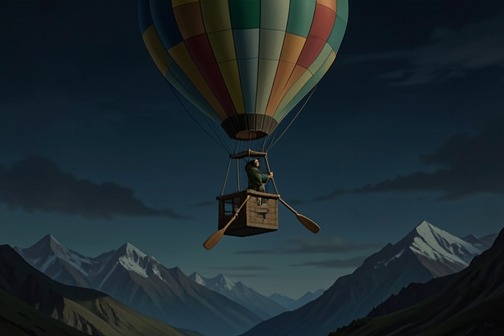
The [Cloud-cutter](entity:object-recall-object-cloud-cutter-0127844fa39f)’s first flight is the moment [Titch](entity:character-recall-character-titch-aeced6aa1952) and Washington Black escape [Faith Plantation](entity:location-recall-location-faith-plantation-022a324e99e0) by air. As the balloon lifts from the mountain, their flight changes Washington’s immediate circumstances: he is no longer confined to the plantation, but his passage into freedom begins under the threat of capture and without any guarantee of safety.
## Preparation and Departure
Titch and Washington reach the peak with their packs as the Cloud-cutter waits tethered in the wind. Titch adjusts the gas canister while Washington climbs into the wicker-and-wood gondola, whose oars and four wings make the craft seem strange and exposed. Washington is afraid, but neither he nor Titch speaks during the preparations; the silence gives the departure the weight of a decision already made.
Titch increases the flame, and the canopy shudders as it fills. He then cuts the ropes one by one. The basket scrapes across the grass before the air takes hold of it, making the final break with the ground both physical and irreversible.
## The Ascent
The Cloud-cutter rises into the darkening sky. Washington grips the oars as the craft begins to move, watching the sky and the plantation recede below. From above, he can make out the half-cut cane fields, a last view of the landscape of forced labor from which they are escaping.
The ascent does not make the danger disappear: the craft spins and climbs, and the air grows colder. Yet Washington’s fear is accompanied by astonishment. He cries quietly as he looks out over the widening world, an emotional response that holds dread and wonder together rather than turning escape into uncomplicated triumph.
## Consequences and Significance
The flight opens the next stage of Washington and Titch’s journey, but it does not itself secure Washington’s legal or physical safety. Later, in [Norfolk](entity:location-recall-location-ead851996a91), Washington learns that a thousand-pound reward has been offered for his capture, with the notice identifying him as an enslaved fugitive and describing his scars and clothing. The escape therefore carries them beyond Faith Plantation without freeing them from the system’s reach.
The flight’s meaning is sharpened by the treatment awaiting those left behind. Under the new master, [Faith](entity:location-recall-location-faith-a5239fbf2174)’s overseers maim and kill enslaved people, and survivors are branded again. Against that violence, the Cloud-cutter’s ascent represents a real break in Washington’s circumstances, while the pursuit that follows shows how precarious that break remains. The scene joins liberation to uncertainty: the craft rises, but the destination is not yet safety.
Event 8
Cloud-cutter crashes into Ave Maria
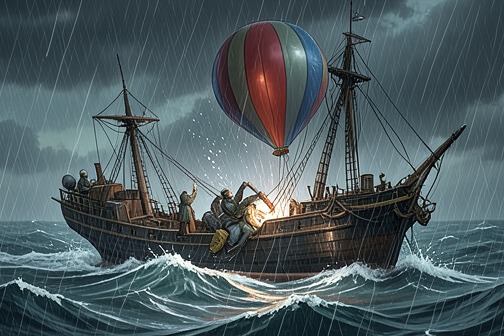
The [Cloud-cutter](entity:object-recall-object-cloud-cutter-0127844fa39f)’s collision with the ship later identified as the [Ave Maria](entity:object-recall-object-ave-maria-52384edb66fb) turns [Titch](entity:character-recall-character-titch-aeced6aa1952) and Washington Black’s escape into a sudden struggle for survival. In a storm that leaves them unable to see clearly and sends their craft plunging toward the sea, Titch deliberately steers for the ship; the collision destroys the Cloud-cutter, but the ship’s captain intervenes and both fugitives live.
## Causes and Circumstances
The collision occurs less than an hour after the Cloud-cutter has left the island. A squall catches the small craft at sea, and Washington, narrating the episode retrospectively, recalls its sudden force and Titch’s immediate work at the ballasts. Titch had checked the barometer and sorted their packages before the storm struck, setting aside items he considered least necessary. Once the winds hit, he throws that pile overboard, an action that suggests he has anticipated the danger and is trying to lighten the craft.
Titch calls for them to rise above the storm, but the attempt does not keep the aerostat aloft. Washington feels it descend through heavy rain, with the balloon fabric under assault and the ocean’s waves visible below. A light briefly appears on the water and disappears again. In the darkness, a ship emerges between the swells, and Washington recognizes that Titch is steering them directly toward it. Their immediate danger is no longer simply the storm: Titch is choosing a collision as their remaining prospect of reaching a vessel.
## The Collision and Rescue
The Cloud-cutter strikes the ship’s mast at an angle, then crashes down onto the deck. It rebounds, hits again, and is dragged across the deck before overturning amid broken wood. Washington is left hanging upside down, tangled in the craft’s ropes, while Titch tries to free him as the wreckage slides toward the ship’s edge. The sequence shifts the escape’s central value from flight to life itself: the device that carried them away from the plantation has become a lethal obstruction.
A man appears behind Titch, pushes him aside, and uses an axe to cut the knot of ropes pinning Washington. Washington falls free and gasps on the deck. Before the men can do more, a gust lifts the balloon upright; the Cloud-cutter scrapes backward, strikes barrels in the fore-rigging, and is pulled into the storm. The craft and its remaining wreckage vanish from their immediate reach, leaving Washington and Titch aboard the ship rather than in control of their own passage.
## Survival and Immediate Aftermath
The rescuing man is the ship’s captain, [Benedikt Kinast](entity:character-recall-character-benedikt-kinast-c1763720c45c), a German by birth and an Englishman by chance. He brings the soaked, exhausted survivors down into the ship’s hold. The sailors are securing ropes and working at the hatches as water enters with the vessel’s movements. Kinast is angry: the collision has damaged his mizzen and victuals, and he demands to know why they were out in such a contraption in a storm. His intervention saves them, but it does not make their arrival uncomplicated; their survival depends on the hospitality of people whose ship they have just damaged.
The narration makes the survival turn explicit immediately afterward: Washington says that they did not die. That short retrospective statement follows the storm and wreck in the narrative sequence, giving the collision the force of a near-fatal threshold. The Cloud-cutter has carried them out of the plantation’s reach, but its destruction ends their flight by air and leaves their next movements dependent on the ship and its crew.
## Place in the Larger Escape
The collision belongs to the flight from [Faith Plantation](entity:location-recall-location-faith-plantation-022a324e99e0) aboard Titch’s Cloud-cutter, a journey undertaken under the pressure of enslavement and the danger of remaining there. Earlier, the plantation’s new master had intensified violence against the enslaved people, including killings and a second branding; Titch’s escape plan therefore answers a coercive regime rather than a routine change of location. At one point the master refuses to risk losing fifteen enslaved workers, making clear that their lives are weighed against the plantation’s labor needs. The storm at sea changes the form of the danger without erasing the conditions that forced Washington and Titch to flee.
After the wreck, Kinast and his brother do not expose or detain the two men. In [Norfolk](entity:location-recall-location-ead851996a91), Washington reflects that the Kinasts had understood something of their history but were more troubled by being lied to than by the substance of the lie. They ask the fugitives to leave discreetly and not identify the ship or its owners when describing how they reached American soil. Their assistance provides temporary protection, not an uncomplicated guarantee of safety: Titch warns Washington to place little trust in strangers because mercy can be revoked. The collision thus marks both a physical rescue and a transfer into a precarious dependence on others.
## Narrative Significance
Washington tells the episode in the first person from a later vantage point, openly distinguishing what he understood in the moment from what he thinks he can recognize afterward. During the storm he sees the ship and realizes Titch is aiming for it; later, he recalls Titch’s earlier attention to the barometer and discarded packages as signs that Titch may have anticipated the squall. This retrospective framing lets the reader encounter the collision first as immediate confusion and danger, then as an episode Washington reconsiders.
The Cloud-cutter’s destruction is a reversal within the escape: Titch’s invention first makes departure possible, then becomes wreckage that traps Washington until the captain cuts him free. Yet the event does not end in death. The men survive, reach a ship, and eventually arrive on American soil, though their freedom remains vulnerable to the choices and discretion of others. The collision therefore closes one means of escape while opening another, less controlled passage onward.
Event 9
Washington Black's bounty notice is discovered in Norfolk
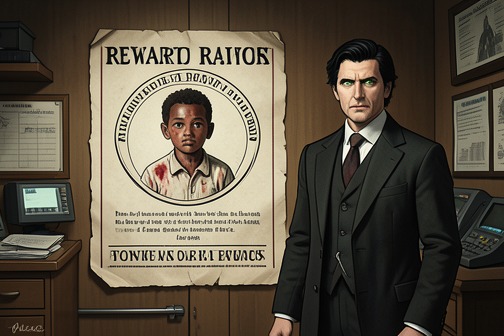
[Washington Black's bounty notice is discovered in Norfolk](entity:event-recall-event-abce62f79352) when [Titch](entity:character-recall-character-titch-aeced6aa1952) shows him a posted reward circular identifying him as an escaped enslaved boy and offering one thousand pounds for his capture, dead or alive. The revelation changes Washington’s flight from a precarious escape into a high-stakes pursuit: the notice names his appearance, describes Titch, and makes the reward a lure to anyone willing to hunt them.
## Discovery and contents
After Titch has left him waiting on a [Norfolk](entity:location-recall-location-ead851996a91) street while he makes inquiries, he later produces a tattered paper that had been mounted in a postal office. He had not wanted Washington to see it, and reads it to him from the page. The circular identifies Washington under the name George Washington Black, describes him as a short enslaved boy for life whose face bears burns, and lists the clothes he was wearing. It warns that he may be travelling with a tall white abolitionist with green eyes and black hair, and promises one thousand pounds to whoever secures him for the issuer, dead or alive.
The notice is signed by [John Francis Willard](entity:character-recall-character-john-francis-willar-1d32f7b6a676), acting agent for [Erasmus Wilde](entity:character-recall-character-erasmus-wilde-686fae23fb63), and gives [Faith Plantation](entity:location-recall-location-faith-plantation-022a324e99e0) in [Barbados](entity:location-recall-location-barbados-a285bae3d98a) as its origin. Its details make the pursuit more than a general threat: it marks Washington’s body and clothing for recognition, while the description of his white companion puts Titch at risk of being identified as someone aiding a fugitive. Washington stares at the paper in shock; the sum is beyond what he can imagine.
## How the threat is explained
Titch identifies Willard as a self-described righter of grievances. He recalls that Willard had attended formal dinners hosted by [Erasmus](entity:character-recall-character-erasmus-1b3a48b98972) soon after the brothers arrived in Barbados, and describes him as a cultivated, soft-spoken former plantation bookkeeper who later hired himself out as a cross-border bounty hunter. Willard had spoken of tracking people over great distances, including enslaved people who had escaped an island, and of working beyond the jurisdiction of any nation. Titch had already understood that Willard had done terrible things, but the notice makes his role in Washington’s danger immediate and personal.
Titch also interprets the notice as a means for Erasmus to reach him through Washington. He tells Washington that his brother does not actually believe Washington responsible for the crime attributed to him; the accusation is a way to get at Titch. That explanation does not reassure Washington. He asks whether Titch can take him to [England](entity:location-recall-location-england-b153c1f368ea), where he hopes he might be safer, and whether Titch could simply pay the reward. Titch answers that a thief-taker pursuing a bounty will not be stopped by the law, and that paying Willard would not end the pursuit: he could take the money and continue hunting for another reward. Titch also says he lacks access to the family purse, since he is the second-born son with only a small living.
## Consequences and wider significance
The circular reveals the practical force of Washington’s fugitive status. Norfolk may be a place where he and Titch can leave their ship, but arrival in American waters does not make Washington safe; Titch’s earlier warning that freedom means different things to different people is borne out by a document that treats the boy as property to be recovered. The bounty converts that claim into a public incentive, extending the danger beyond Erasmus and Willard to anyone attracted by the money.
The threat continues to shape Washington’s later life. In [Nova Scotia](entity:location-recall-location-d59dfadbcba8), he remains afraid that Willard’s agents or other kidnappers might seize him and return him to slavery; he grows watchful and solitary after an attack by a local man whom he fears might be connected to the hunt. Years later, Willard recognizes him in the street by the scar that the notice had made a mark of identification. He tells Washington that he searched for him for years, lost business and standing after failing to find him, and regarded that failure as defeat. The Norfolk discovery thus begins a pursuit whose effects persist long after Washington has escaped the immediate reach of the plantation.
## Narrative significance
The scene turns a document into a mechanism of plot: a printed description joins Washington’s visible scars to a network of money, ownership, and pursuit. Its precise details make the threat legible, while the reward’s scale makes clear why simple flight or payment cannot settle it. The notice also exposes the gap between nominal freedom and actual protection: Washington may travel beyond Barbados, yet the claim that he is property can still follow him across borders and enlist strangers in his capture.
Event 10
蒂奇与华盛顿投宿埃德加·法罗处并得知父亲可能在世
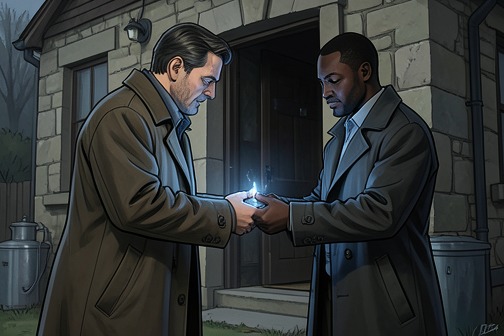
Christopher Wilde and Washington Black’s stop at St. John’s becomes a turning point: a night’s shelter with [Edgar Farrow](entity:character-recall-character-edgar-farrow-b041773de001) leads to evidence that Christopher’s father, James Wilde, may still be alive. The letters offer no certainty, but they transform an old loss into an unresolved possibility and set Christopher facing a choice between disbelief and hope.
## Arrival at St. John’s
After rounding a bend in the slope, Christopher and Washington see St. John’s. They seek shelter at Edgar Farrow’s home, not to sell anything, but to accept the refuge he can provide. Christopher introduces himself by his full name and explains that, although Farrow may not recognize his face, he may know his work: the two have corresponded for two years about pressure changes during aerostat ascents and their effects on the human body. Christopher also identifies James Wilde as Farrow’s associate in the [Royal Society](entity:organization-recall-organization-royal-society-b1e81590bc74).
The introduction establishes that Christopher arrives not merely as a traveler but as a scientific correspondent with connections to Farrow and to his father. That connection makes the documents Farrow produces more than a chance discovery: they concern the very person whose possible death has shaped Christopher’s expectations.
## The account of the journey
At Farrow’s home, Christopher recounts the recent events of the journey. He describes the storm and the [Cloud-cutter](entity:object-recall-object-cloud-cutter-0127844fa39f)’s descent onto the deck of the [Ave Maria](entity:object-recall-object-ave-maria-52384edb66fb). The ship’s name startles Washington, who does not look at Christopher; he turns toward him only when Christopher mentions his cousin’s death and the bounty on Washington’s head. The gathering therefore brings together two kinds of danger: the immediate consequences of their flight and the longer, uncertain question of Christopher’s family.
Christopher’s account makes the evidence about his father arrive amid news of death and pursuit, rather than in isolation. The contrast matters: the journey has already shown how quickly a person can be lost, while the bounty keeps Washington’s own freedom precarious. Against that background, the possibility that James survived is powerful without being conclusive.
## The letters and their implications
Farrow responds by bringing out a dog-eared ivory envelope bearing his name in a fine hand. He takes out pages and separates them into two stacks on the table: one contains a letter from James, the other a letter from James’s assistant, [Peter House](entity:character-recall-character-peter-house-ada0facbef1f), mailed alongside it. The paired correspondence supplies a concrete basis for reconsidering what Christopher had believed about his father.
Christopher studies the letter from James and focuses on its penultimate paragraph. It refers to Christopher having been at [Faith](entity:location-recall-location-faith-a5239fbf2174) for nearly a year. Christopher takes that reference as evidence that the letter is very recent, and his reaction is dispirited and aggrieved: the writing appears to place his father’s communication much closer to the present than he had expected. The letters raise the possibility that James is alive; they do not, on the evidence available at Farrow’s home, verify his whereabouts or explain why he has not returned.
## Hope without certainty
Christopher rises with a sigh. The narration observes that extraordinary events are rare even for people who devote their lives to studying them, yet his longing to believe is plain. That tension defines the scene’s outcome. Farrow’s documents do not resolve the mystery, but the date implied by the letter and the presence of a second, accompanying message make the possibility difficult to dismiss.
The scene shifts Christopher from the apparent finality of bereavement toward a tentative hope that his father may be living. Its force lies in that incomplete reversal: evidence opens a future course of inquiry without promising reunion. For Washington, present as witness to Christopher’s response, the encounter also places their escape alongside a different kind of search—one driven not by a bounty or immediate shelter, but by the chance that an absent family member remains somewhere beyond the known story.
Event 11
华盛顿决定随蒂奇前往北方
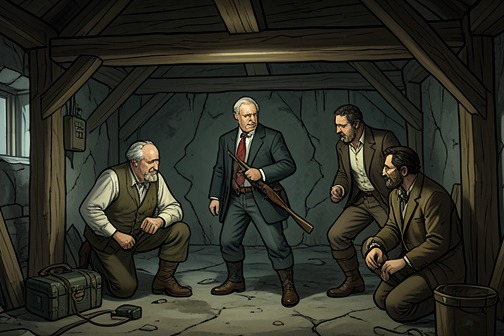
Washington Black’s decision to follow [Titch](entity:character-recall-character-titch-aeced6aa1952) north takes place in a hidden refuge for people escaping enslavement, where a practical offer of safety becomes a test of what freedom means. Titch points Washington toward Upper Canada, but Washington chooses instead to share Titch’s perilous journey to the Arctic. The decision is at once an assertion of self-determination and an act shaped by fear, gratitude, and attachment.
## The refuge and the choice
The choice emerges after Washington follows a gravedigger through a concealed passage beneath an apparently empty grave. The boards he had taken for a coffin lid have been moved aside; a second ladder descends into a narrow earthen passage, which leads to a low chamber supported by timber. There Washington finds Titch, the gravedigger, and two men escaping enslavement. The setting makes their discussion of freedom immediate: they are concealed underground while arranging a route toward safety above it.
Titch identifies the two men as Adam and Ezekiel and says they are to leave the following night. He expects them to reach Upper Canada before the end of the month. The gravedigger clarifies the legal basis for the plan: an enslaved person who reaches Upper Canada will be freed on arrival. For Washington, this is not an abstract promise. Titch presents departure with the two men as a chance to save his life, and to disappear among Loyalist communities where he might be safer.
## Titch’s plan and the danger of remaining
Titch’s advice is shaped by his own destination. He tells Washington that he is going to the Arctic to find out what happened to his father and see his resting place. He also explains that his brother will be near for as long as Washington remains with him, and that his brother will not relent. In Titch’s judgment, remaining at his side exposes Washington to danger; going north with the fugitives offers a better chance of survival.
That danger is part of a broader pursuit. Earlier, Titch had explained that reaching [Norfolk](entity:location-recall-location-ead851996a91) and entering [Chesapeake Bay](entity:location-recall-location-4b869b84fc2b) would bring them under American laws of freedom, but warned that freedom meant different things to different people. A posted reward notice makes the threat concrete: [John Francis Willard](entity:character-recall-character-john-francis-willar-1d32f7b6a676), acting for [Erasmus Wilde](entity:character-recall-character-erasmus-wilde-686fae23fb63), offers a thousand pounds for Washington’s capture, dead or alive, and identifies him as an enslaved boy for life. The notice names Washington’s burn-marked face and describes the clothes he is wearing, turning his body and appearance into tools of the search. The refuge’s offer therefore stands against an active attempt to claim him as property again.
## Washington claims the right to choose
Washington understands that Titch is telling him he may die if he refuses the safer route. He nevertheless insists that being a free man means deciding where to go, even if that decision leads into hiding in the Arctic. Titch agrees that it is Washington’s choice. The exchange distinguishes legal or promised freedom from the agency Washington is trying to exercise: the choice may be dangerous, but it is his to make.
The later narration does not simplify his motive into uncomplicated courage. Washington considers whether he acted from fidelity, gratitude for kindness he had not been accustomed to receiving, or the belief that Titch was the only family left to him. He cannot settle the question. What he remembers clearly is the terror of undertaking a journey without Titch; separation feels almost unbearable. The decision thus combines a stated principle of self-determination with an attachment that limits how freely the alternatives feel.
## The choice’s cost and aftermath
Washington stays seated on the chamber’s boards, grim and resolved. Titch looks pained and taken aback, but says nothing more. His silence leaves the disagreement unresolved: Washington has chosen to accompany him, while Titch had wanted him to take the safer passage north with Adam and Ezekiel.
The decision does not deliver Washington into secure freedom. After spending several weeks at a northern outpost, he resolves to seek the Loyalists and arranges passage to the Maritime islands. At sea he fears being sold to a ship bound for the Slave States and avoids the captain. In [Nova Scotia](entity:location-recall-location-d59dfadbcba8), he finds that the expected refuge is precarious: in Shelburne, Black residents receive poor land and scarce supplies, while kidnappers patrol the coast and may seize freed people and carry them back into slavery. His journey shows the gap between a legal promise of freedom in one place and the continuing vulnerability of a Black fugitive across borders.
That vulnerability later resurfaces when Willard recognizes Washington in Nova Scotia. Willard says he had searched for years and that Washington’s scar betrays him, confirming that the old reward pursuit has not simply ended with Washington’s departure. In [England](entity:location-recall-location-england-b153c1f368ea), racial exclusion likewise follows him into public life: during the crossing with Goff, a passenger objects to Washington’s presence on the viewing deck, and Goff angrily challenges the insult. The choice to follow Titch is therefore not a single escape from danger but the beginning of a longer struggle to make a life where movement, legal status, and other people’s judgments continue to shape his safety.
## Narrative significance
The episode turns the language of freedom into a conflict over who gets to decide. Titch offers protection by directing Washington toward Upper Canada; Washington refuses the protection on those terms and chooses the Arctic journey with him. His declaration is an act of agency, but the remembered panic at separation keeps the moment from becoming a simple triumph. The underground refuge, the escape route, and the reward notice place private attachment within a larger landscape of fugitive law and racialized pursuit: choosing freely matters, yet the available choices remain narrowed by the danger of being treated as property.
Event 12
Titch reunites with his father in the Arctic
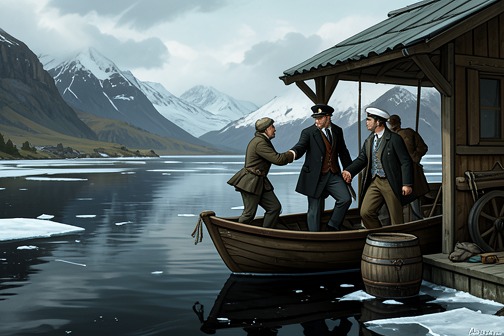
[Titch reunites with his father in the Arctic](entity:event-recall-event-def98a6f9ccd) after travelling north on the belief that [Mister Wilde](entity:character-recall-character-mister-wilde-5934725acb51) is dead. The news arrives through [Peter House](entity:character-recall-character-peter-house-ada0facbef1f), who communicates with gestures, and the reunion turns [Titch](entity:character-recall-character-titch-aeced6aa1952)’s long pursuit into a complicated encounter: his father is alive, but treats the journey as a mistake rather than a homecoming.
## The journey to the outpost
Near the end of the northward journey, Titch and Washington Black reach a trading post by the Bay. The waters are black and still, dotted with ice; Titch shakes hands with Captain Holloway and [Jacob Ibel](entity:character-recall-character-jacob-ibel-1feaa7c009ef) before the two travellers climb into a small cutter and are rowed toward the post’s leaning wooden shacks. The scene marks a transition from travel across the northern landscape to the outpost network through which Titch’s father’s isolated camp can be reached.
At the post, the travellers encounter Peter House, whom they had feared might be dead. House had been collecting goods there by chance. His presence is decisive not simply because he can guide them onward, but because he brings news that changes the meaning of Titch’s expedition: the report of his father’s death was false.
## Peter House reveals the truth
Titch recognizes House and takes both his hands. The reunion is wordless: the two men laugh quietly, then communicate through elaborate gestures, House slapping his chest and shaping his fingers while Titch watches and responds. Washington, unable to follow their exchange, sees Titch swipe at his eyes and recognizes his relief and happiness. From their gestures, Titch understands that his father lives.
House then takes the provision sack from Washington and heads toward a distant sled. As they follow, Titch tells Washington plainly that his father is alive and explains that House does not speak but communicates with his hands. The revelation resolves the uncertainty that has governed the journey, while leaving the travellers with the immediate task of reaching the camp and meeting the man whose supposed death brought them there.
## The encounter with Mister Wilde
Inside the camp, Washington first sees Mister Wilde rising from the shadows. The contrast between the celebrated figure Titch has sought and the living man before them is striking: Mister Wilde is short and stout, with a notably unattractive face and wooden replacements for his four front teeth. Washington’s description recalls the stature of his reputation—his scientific distinction, travels, languages, and influence on Titch—before returning to the unexpected physical reality of the father himself.
Titch is paralyzed with astonishment. He embraces his father with visible anguish; Mister Wilde pats his back, appearing embarrassed by the display of affection, then quickly disentangles himself and gestures for the visitors to follow. Titch trails after him unsteadily, still overwhelmed. Washington understands the force of the reversal: Titch has spent months believing his father dead, and now must absorb the shock of finding him alive.
Mister Wilde leads them to another igloo, where members of his small encampment are eating. The people there look past Titch and watch Washington, a burned Black boy in an unfamiliar setting. The camp is not a simple reunion space: Mister Wilde and Peter House depend on the Inuit people and their support to survive in the plains, although Washington observes that Mister Wilde appears to have little direct communication with them. House serves as his intermediary and his principal companion.
## A reunion without the expected return
Once the group has settled, Mister Wilde says that he knows why Titch has come: Titch believed him dead. When Titch objects that his father may not understand his reason, Mister Wilde insists that the mistaken belief is precisely the explanation. The exchange exposes a gap between the emotional weight of Titch’s journey and his father’s brisk account of it. The reunion confirms survival, but it does not immediately provide the intimacy or welcome Titch may have hoped to find.
Mister Wilde thanks Christopher for coming so far, yet calls the journey a fool’s errand. He does not know what Titch wants from him. Titch falls silent and looks down at his hands; after a pause, he asks his father not to mention his visit when writing to her. The request points beyond the immediate reunion to a relationship and history not explained in the encounter itself, and underscores Titch’s wish that his arrival remain undisclosed.
## Significance
The reunion reverses the expedition’s central assumption without erasing its costs. Titch and Washington have travelled through danger to find a man whose death they believed established; instead, they meet an alive but distant father. The scene gives physical form to the difference between pursuing an imagined reunion and confronting the person who has survived. Its emotional center is not a triumphant homecoming but Titch’s stunned embrace, followed by his father’s embarrassment, practical haste, and insistence that the journey was unnecessary.
The event is also filtered through Washington’s perspective. He cannot understand House’s silent conversation until Titch explains it, and he watches the reunion from the position of a companion who can recognize Titch’s relief without sharing the father-son bond. That limited but attentive viewpoint makes the discovery arrive first as gesture and bodily reaction, then as spoken confirmation. The long-awaited truth is clear; what the reunion means for Titch remains unresolved in the scene.
Event 13
Titch disappears into an Arctic blizzard
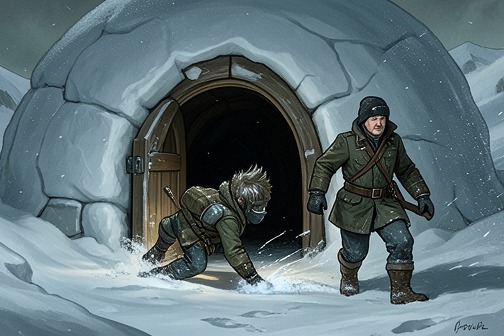
[Titch disappears into an Arctic blizzard](entity:event-recall-event-c99510306157) after telling Washington Black that his life is not [Titch](entity:character-recall-character-titch-aeced6aa1952)’s to command and that provisions and money have been arranged for him. Washington, then thirteen and dependent on Titch in the remote northern landscape, follows him into the storm rather than accept the promised safety of staying behind. Titch’s disappearance leaves no confirmed death or body: it is at once an act of separation, a crisis of care, and an absence that Washington carries into his later search for Titch.
## The Parting in the Storm
In a small igloo, Titch tells Washington that he has made arrangements with Peter to keep him safe, and that he has left money and provisions. His words present the separation as protection, but Washington recognizes a pattern: Titch had tried before to free himself from Washington under the guise of granting him safety. The assurances cannot settle what is happening between them. Titch crawls out into the cold with his pack, and Washington follows.
Outside, wind drives the snow at an angle and pushes Washington sideways. He sees Titch’s crooked silhouette heading south, while the footprints behind him begin to fill with snow. Washington is thirteen, afraid of the prospect of making his way alone, and conscious that he has no one else in the world. He does not rush ahead or lose sight of Titch; he struggles through the deep snow after him.
Titch calls Washington a ghost and orders him to go back. Washington instead asks them both to wait for the weather to pass and then travel to the trading post together, judging it madness to continue in the storm. Titch warns him to stay put if he cannot find the path, because someone will find him. But Washington hears the warning alongside Titch’s repeated command to return, and does not accept it as a reason to part.
## The Disappearance
Titch drops his pack into the snow between them. He faces Washington, takes several steps backwards into the storm, then turns into the wind and starts walking. Washington struggles to lift the pack and calls out that it is too heavy. Titch answers, but continues away. He enters the whiteout, and the storm closes around him until he is lost from Washington’s sight.
The sequence ends without a witnessed death, a body, or a clear account of Titch’s destination. Washington describes Titch as walking calmly out of his life, but the disappearance remains unresolved rather than confirmed as death. That distinction governs what follows: the loss is real in its immediate effects, while the question of whether Titch lives remains open.
## Search and Abandonment
After Titch fails to return, Peter and the Inuit searchers come back without him and set out again at first light. The searches continue without finding him. James Wilde becomes increasingly restless, eats and sleeps little, and waits at the entrance of his igloo, watching the horizon. Eventually he gathers his survival tools and goes into the snowy wastes himself; Peter follows at a distance to help ensure that James, too, is not lost.
When James returns without Titch, Washington understands that he has been abandoned and that he alone must now see to his safety. He believes Titch will not return from the wastes. The realization does not depend on certainty about Titch’s fate: the failed searches and Titch’s absence are enough to end Washington’s expectation that his former protector will come back.
## The Long Aftermath
Years later, Washington recalls that his life before Titch was wrenched onto a course of wonder and then loneliness and destitution. He describes his later life as built around an absence, despite its richness, and recognizes that he still needs to know whether Titch lived and to confront him. He therefore decides to go to [Granbourne](entity:location-recall-location-granbourne-b0c4f3a26ab8) and seek Titch there, reasoning that the estate may remain a sanctuary to which Titch would be drawn. Washington writes to him and receives a reply from Titch’s mother, renewing the possibility of contact without resolving the old disappearance.
In [Amsterdam](entity:location-recall-location-ff526395fd98), [Peter Haas](entity:character-recall-character-peter-haas-6c6602179b97) tells Washington that Titch had visited about a year and a half earlier, stayed for some weeks, and was long gone. This later confirmation establishes that Titch survived the Arctic disappearance for at least that period, but it does not explain where he went or what became of him afterward. When Washington eventually sees Titch again, he asks where Titch went after leaving his father’s camp and why the search party never found him. The disappearance thus remains a question Washington brings to their eventual encounter, rather than a closed episode.
## Narrative Significance
The account is told retrospectively by Washington, who admits that he has weighed the afternoon for years without being able to give it a clean explanation. He was young, terrified, and confused; with time, even the nature of what happened has shifted in his understanding. That qualification makes the scene more than a simple report of a man entering a storm: the remembered sequence preserves Washington’s uncertainty about Titch’s intention while firmly recording the consequence for the child left behind.
The event also reverses the language of safety. Titch says he has made provision for Washington and urges him to stay where he can be found, yet Washington experiences the departure as another attempt to liberate Titch from him. Following Titch is dangerous, but remaining behind would mean accepting separation on Titch’s terms. The blizzard turns that relational conflict into a physical distance that grows until Titch can no longer be seen, while the unresolved fate leaves Washington with a loss that cannot be settled by mourning alone.
Event 14
詹姆斯·怀尔德在北极营地病逝
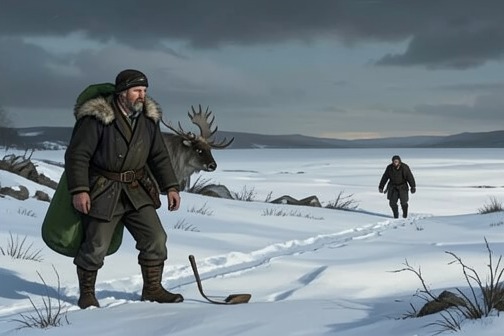
James Wilde’s death in the Arctic is the final loss in a sequence of absences that leaves Washington Black alone in the northern camp. After [Titch](entity:character-recall-character-titch-aeced6aa1952) disappears into the snowy wastes, James sets out to search for his son, returns without finding him, and falls ill. Washington watches over him and draws him as his condition declines. When James dies, Washington recognizes that Titch will not return and decides to leave; [Peter House](entity:character-recall-character-peter-house-ada0facbef1f) helps him depart with provisions, money, books, and instruments that connect his uncertain future to the life of observation and study he has begun to build.
## The Search for Titch
After searchers return without Titch, James grows increasingly restless. He sleeps little, eats less, and keeps watch at the entrance of his igloo rather than tending the traps. At last he gathers his survival tools into a large green sack, puts on a freshly oiled caribou skin, and sets out across the snow. The local people try to dissuade him, but Peter House signals that they should let James go and follows at a distance of about fifty paces, intending to keep him from being lost as well.
Several days later, James and Peter return together across the plain. James has not found Titch. Washington is anxious for news, but James passes him without answering and enters the igloo. He curses Titch as a foolish boy who has always run away and hidden, yet Washington can see that James does not believe his son will come back this time. The failed search makes the possibility of Titch’s permanent absence harder to evade.
## Illness and Death
James briefly acknowledges Washington’s situation, telling him he should be all right because there are provisions and clothing. He also refers to Washington’s recent sketch of a whale’s horn, praising its faithful rendering and suggesting that he draw more. The small exchange joins practical reassurance to a recognition of Washington’s ability, but it does not restore the security that Titch’s disappearance has taken away.
Some hours later, James falls gravely ill. He lies bundled in furs, alternately shivering and throwing them off in fever. Peter brings soups, potions, and tinctures in an effort to treat the infection, but James’s condition worsens as Titch remains missing. Washington accompanies Peter on the morning checks of the traps, though they find nothing; the walks offer a way to turn his mind from his fear, not a solution to it.
In the afternoons Washington watches James while Peter makes trips to the outpost. The old man lies with his eyes closed and his breathing shallow. Washington fetches his drawing materials and sketches him, attending to the details of his appearance. As he works, he thinks both of Titch, who may still be alive somewhere beyond the camp, and of earlier events that led to his own escape from [Faith Plantation](entity:location-recall-location-faith-plantation-022a324e99e0). James’s death therefore arrives within a layered recollection: Washington is caring for a dying man while reconsidering how another man’s death once changed the course of his life.
Washington eventually pauses his drawing and realizes that James has stopped breathing. His face is still, and one arm lies across his body: he is dead. The narration establishes the death through Washington’s close observation rather than through a formal announcement or a scene of farewell.
## Aftermath and Departure
James’s death confirms what Washington has feared: Titch is not returning to the camp, and Washington has been left without the person who brought him there. He understands that he must now look after his own safety. Peter and the local people carry James away, while Washington remains in the igloo, staring at his torn mittens. The practical loss is accompanied by a decisive change in his circumstances: the camp can no longer be treated as a place where Titch might return and restore the life Washington expected.
Washington does not want to remain in the Arctic. Accustomed to the warmth and sea air of the Indies, he feels confined by the cold, despite the blankets, animal hides, and fire. He knows Peter and the others will try to protect him, but cannot tell for how long, so he gathers his belongings and tells Peter he intends to leave.
Although Peter has lost his closest companion, he responds with care. He lets Washington choose among the Wildes’ possessions; Washington selects a leather-bound treatise on marine life, and Peter adds several of James’s hand lenses. He also gives Washington the skin of money Titch had left for him, along with food and other provisions. At the outpost Peter places additional small scopes in Washington’s mittens: compact, handmade models belonging to Titch, with dark gears for knobs. Peter and [Hesiod](entity:character-recall-character-hesiod-9a0217ee6999) set Washington on a sled and lead him out across the snow.
## Narrative Significance
The death brings one uncertainty to an end while leaving another unresolved. James, whose death had previously been treated as legendary or presumed, now truly dies in the camp; Titch, by contrast, remains missing. Washington’s decision to leave follows from the combination: he cannot wait indefinitely for Titch, and James’s death removes the remaining family connection that had anchored him there.
The objects Peter gives Washington make the departure more than an escape from the cold. The marine-life book and hand lenses belonged to James, while the self-made scopes belonged to Titch; carried together, they preserve material traces of both men without resolving Washington’s separation from either. The sequence ends not with a reunion or explanation but with Washington sent into the wastes, equipped to continue independently. The death thus marks a painful turn from reliance on the Wilde household toward a future Washington must make for himself.
Event 15
华盛顿看见发光水母并重新开始绘画
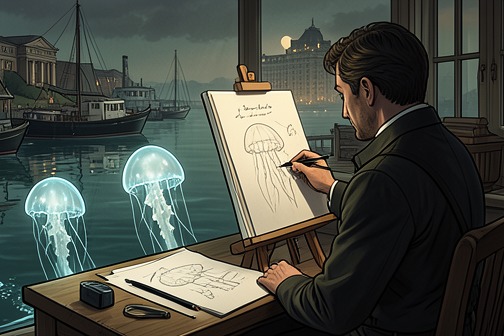
Washington Black’s sighting of luminous jellyfish in the harbor marks a return to drawing after months in which work, racism, and the aftermath of [Titch](entity:character-recall-character-titch-aeced6aa1952)’s disappearance have narrowed his life. The encounter does not erase those injuries, but it restores his attention to the natural world and to an ability he had feared was lost: the capacity to look closely, make images, and find calm in the act of making them.
## Background: A talent first kept secret
As a child enslaved at [Faith Plantation](entity:location-recall-location-faith-plantation-022a324e99e0), Washington began drawing in secret with supplies Titch gave him: a ream of paper each week and a black drawing lead. By candlelight he sketched whatever lay at hand, attending to the shadows that gave objects weight. He feared the consequences if his master discovered this disobedience, so each night he rolled up his finished drawing and held it over the flame until it became ash.
The secrecy ended when Titch recognized a drawing of a [Cassius blue butterfly](entity:creature-recall-creature-cassius-blue-butterf-46743cc4b84d). He praised Washington’s faithful rendering of nature and called him a prodigy. The next day he gave Washington drawing leads and illustration boards, made him chief illustrator, and urged him to be faithful to what he saw rather than to what he was supposed to see. Drawing thus began as a prohibited private practice and became, under Titch’s encouragement, both a discipline of observation and a form of recognition.
## The harbor encounter
Years later, at sixteen, Washington was living in [Nova Scotia](entity:location-recall-location-d59dfadbcba8) and taking intermittent work on the docks. He tried to govern his own labor, holding to [Big Kit](entity:character-recall-character-big-kit-7bc19d4cb80d)’s idea of freedom: a free person could put down the shovel when he chose. Yet his attempt at independence met the violence of white men. Co-workers called him a racial slur and kicked him; on one occasion they held him down in an alley, beat him, and urinated on him. His burns compounded the burden of living in a society that treated his body as a target.
One night, while hired to unload a sailing vessel, Washington rowed a crate ashore and noticed sudden flashes in the black water. Green and yellow lights appeared in succession, like small bursts across the surface. The sea seemed smooth, yet translucent beneath the ship’s light; wide, transparent green and yellow orbs pulsed there, followed by dozens more, glistening like suns. Washington had seen jellyfish on visits to beaches near [Faith](entity:location-recall-location-faith-a5239fbf2174) with Titch, but never in such numbers or with such vividness. Against the far-reaching darkness, their fragile bodies seemed to burn with color.
The sight held him over the side of his little rowboat until the dock master’s curses brought him back to his work. When he resumed rowing, the oars scattered the light. The moment was necessarily brief: the creatures’ radiance remained visible only while he watched, and the demand of his job interrupted his attention before he could preserve what he had seen.
## Drawing again
Back at his boarding house, Washington took out his papers and paint and sketched for the first time in months. He could not capture the spectacle as he had experienced it. He remembered it as a sudden, fleeting incandescence, with each punch of light like a note of music. The distance between the living sight and his imperfect image did not make the attempt pointless; it gave him a reason to begin again.
The experience opens into a more sustained return to artistic practice. Washington finds permanent work as a delivery man for Fummerton’s Dry Goods, whose mid-morning-to-late-afternoon schedule leaves him time to sketch in the salt air. Looking at his drawings, he is startled by how much his hand has weakened after years of rest. He recalls that at eleven, untrained and enslaved, he had drawn tree frogs, wind-blown palms, and human feet with an unnerving vividness. Now he must retrain a skill that once seemed innate. Rather than discouraging him, the need for practice makes the return tangible: the work brings him calm and peace, and with them a renewed sense of curiosity.
## Observation, memory, and authorship
Washington’s renewed drawing connects the harbor scene to the beginnings of his artistic life. As a boy, he learned to observe the details of the world under Titch’s direction; as a young man, he must recover that attention after violence and years away from the practice. The change is not simply a return to an old talent. He recognizes that a gift can atrophy and that its recovery requires deliberate effort, even as the act itself offers a measure of steadiness.
The earlier drawings also establish that Washington’s skill could carry scientific and public significance. Titch’s paper bears the credit line naming Christopher Wilde as author and George Washington Black as illustrator, and Titch tells him that publication in the [Royal Society](entity:organization-recall-organization-royal-society-b1e81590bc74) will make him a man of science. Yet the harbor sketch begins in a more private register: it is an attempt to hold a sight that cannot be kept. Later, Titch’s experiments with photographs—polished silver-plated copper treated with fumes and exposed at midnight—likewise test how an image can preserve a subject, and how distance affects what becomes visible. Across these episodes, seeing is neither passive nor guaranteed to produce a faithful image. Washington’s practice depends on attention, repeated work, and the recognition that a drawing may fall short of the world it records.
## Significance
The jellyfish do not rescue Washington from the hostility around him, and the sketch cannot reproduce their fleeting light. Instead, the scene gives him a point of return. In the darkness, a natural display interrupts a period of isolation and draws him back toward the papers and paints he had put aside. The interruption becomes consequential not because it resolves his circumstances, but because it renews his capacity to notice, to make, and to choose a practice for himself. His later employment gives that choice room to continue; his willingness to relearn makes it his own.
Event 16
Washington meets Tanna Goff for the first time
Washington Black meets [Tanna Goff](entity:character-recall-character-tanna-goff-04093610691a) for the first time on a [Nova Scotia](entity:location-recall-location-d59dfadbcba8) shore where they have already spent two weeks sketching side by side without speaking. The encounter transforms a cautious arrangement into an intimate relationship: [Tanna](entity:character-recall-character-tanna-7e2f4be68e90)’s frankness challenges Washington’s solitude, and her open desire briefly gives him a sense of himself as a man intact.
## The shoreline before the meeting
Washington’s mornings at the tide pools have become a rare pocket of self-directed life. He wades among anemones, crabs, sea urchins, and other small creatures, then sketches what he finds. For him, the work is more than a pastime: at his easel, his hours and concerns belong to him. The quiet is precarious, however. One morning he notices a distant figure setting up an easel about half a mile away and initially fears that the stranger may be a bounty hunter who has seen [John Willard](entity:character-recall-character-john-willard-08a14a567020)’s notice.
The stranger returns on successive mornings. Washington first leaves early, then gives up sketching altogether, convinced that even this inlet will be taken from him. Gradually, though, he reinterprets their distance. He raises a hand; the other artist waves back. Their greetings become a daily ritual, each working separately across the strand. Washington wonders what the stranger is painting and recognizes the odd intimacy of sharing his private hours with someone whose face he has never seen. The separation preserves their independence even as it prepares the ground for an encounter.
## Tanna approaches
The balance changes when Washington sits sketching a hermit crab’s silver shell. A shadow falls across his paper, and the stranger praises the drawing. Turning from the page, Washington sees Tanna for the first time. She is short, dressed in oversized trousers rolled to the knees, with black hair pinned tightly at her nape and a soot-stained plaster cast around her left hand. Her working hand bears paint stains. Her appearance does not fit the assumptions Washington has made from afar, and her ease in approaching him unsettles the solitary routine he had come to protect.
Tanna introduces herself and explains that she thought it proper to make their acquaintance after their two weeks of painting alongside one another. Washington gives his name as George Washington Black. She playfully alludes to the places he has traveled, including the Delaware and the [Labrador](entity:location-recall-location-8632a8f4c19e) Sea; he does not understand the joke. He admits that he had thought her a man because of the distance between their easels. Tanna takes the mistake lightly, observing that her trousers made it understandable, and says that people have said worse when standing closer.
## An artist and a companion
Tanna asks whether Washington can teach her to paint. The request reveals that she is not primarily seeking his knowledge of marine life: she knows the whelks and other creatures well, but wants instruction in depicting them. Her interest brings his skill into a new kind of relation. Washington has valued drawing as an activity that belongs to him alone; now another artist asks to learn from him, and his solitary practice begins to open into companionship.
Their subsequent mornings retain the rhythms of the first meeting while changing their meaning. Tanna begins to dress in more feminine clothing, though not in the voluminous styles conventionally expected. She waits at the shore and waves with her uninjured hand. They greet one another quietly, roll up their cuffs, and wade together as Washington points out crabs, fish, limpets, slugs, worms, and starfish. Tanna studies the creatures intently, trying to commit them to memory. The scene makes their partnership both practical and reciprocal: he shares what he has observed in the water, while she approaches him as an artist whose work merits attention.
## Intimacy and the body
The first meeting develops into a more personal connection when Tanna takes Washington’s hand. He flinches at the contact but does not pull away. She tells him that he will show her how to draw, and her narrowed eyes and intimate smile make clear that her interest is not confined to instruction. Washington is startled by the openness of her desire, but also by seeing that desire reflected in her face. The moment produces a bodily shift: he becomes conscious of his shoulders, height, and voice, and feels, briefly, like a man made whole.
That recognition sits alongside the scar on his right cheek, which Tanna notices and asks about. Her question brings his disfigurement into the encounter without making it the whole of his identity. Washington feels drawn toward her, yet the force of the feeling frightens him. As he senses her closeness, his breath sharpens and fear rises; he lets go of her hand and steps back from the intimacy he had wanted to approach. The meeting thus opens desire and self-recognition without resolving his alarm or erasing the bodily history that makes closeness difficult.
## A relationship shaped by unequal freedoms
The shore’s apparent privacy is shadowed by the unequal conditions under which Washington and Tanna move through the world. Washington is a Black fugitive who has survived enslavement and fears capture; even in Nova Scotia, he has encountered kidnapping threats and racial hostility. His freedom at the water’s edge is real but vulnerable. Tanna, meanwhile, is a young woman whose father, [G. M. Goff](entity:character-recall-character-g-m-goff-4f9ee1545e4f), later explains that she had been coming to the tide pools early to paint and that he insisted on accompanying her for safety. She would rather remain at home than have her freedom compromised. Her plastered wrist also marks a recent injury, though the first encounter itself does not explain how it happened.
Their meeting therefore joins artistic recognition to the question of who can claim time and space without supervision or threat. Washington’s first response to the stranger is fear of being hunted; Tanna’s repeated presence has been shaped by paternal protection that she experiences as a limit on freedom. Their shared work offers a brief practice of companionship in which each can attend to the water and to the other’s skill. But the scene does not make their circumstances equivalent: racialized danger, gendered constraint, age, and bodily vulnerability shape their different forms of exposure, even as the shoreline allows their interests to meet.
Event 17
Washington discovers an orange octopus
Washington Black’s discovery of an orange octopus becomes a turning point in how he thinks about scientific observation and public display. In the wreck he is searching, he encounters a living creature that draws him into an exchange rather than a simple act of collection; imagining it killed for exhibition makes him question the purpose of specimens and propose showing marine life alive. That idea will become the basis of [Ocean House](entity:location-recall-location-ocean-house-2184634806a2), even as his contribution to its creation remains vulnerable to erasure.
## The dive and discovery
During a dive to investigate a wreck, Washington Black encounters a jellyfish and moves carefully through the cold water toward the barque. At the wreck, an orange flash catches his attention. As he approaches, the object seems to change shape and color before the creature rises from its resting place, its arms spreading around it. The discovery is not merely visual: Washington recognizes that it is a female and responds to the encounter with hope.
## An encounter, not a specimen
The octopus’s movements make the meeting reciprocal. It releases ink when Washington comes closer, then pauses in the water before approaching him again. Washington holds out his hands, and the octopus swims into them. Its living presence prompts him to imagine a different kind of exhibition. He does not want it killed and packed as a specimen; he wonders whether it, along with other marine animals and plants, could instead be transported alive for people to see.
## From observation to an exhibition
Washington understands that the proposal presents serious practical problems: what could house the animals, which species could live together, and how could marine life and plants survive transport? The difficulty does not extinguish the idea. Later, he describes to [G. M. Goff](entity:character-recall-character-g-m-goff-4f9ee1545e4f) a permanent public gallery filled with large tanks and open-air terrariums, where visitors could watch aquatic life at close range and learn its habits. Goff initially objects that such a scheme is impossible, while [Tanna Goff](entity:character-recall-character-tanna-goff-04093610691a) gives the vision a concise name: a menagerie of the sea.
## Ocean House and the question of credit
The proposal eventually receives the Zoological Committee’s enthusiastic approval. In [London](entity:location-recall-location-london-420923d4a60a), the city provides land and permits an old building in the zoological gardens to be repurposed for the permanent exhibition, which will be called Ocean House. Washington regards it as an idea of his own, in contrast to the [Cloud-cutter](entity:object-recall-object-cloud-cutter-0127844fa39f), which he had worked on but understood as [Titch](entity:character-recall-character-titch-aeced6aa1952)’s vision. Yet he expects G. M. Goff, not Washington, to be celebrated as Ocean House’s founder. His work is present throughout the exhibition—in the tanks’ dimensions and materials, the selection of animals, and the arrangement of aquatic plants—but his name is absent. The discovery thus leads to a public project built around careful seeing while exposing how recognition and authority shape whose work becomes visible.
Event 18
活体水族展览构想的提出与获准
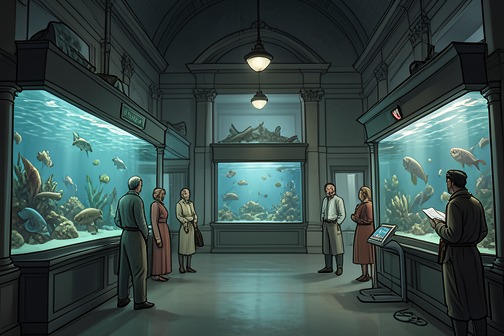
Washington Black’s proposal for a permanent exhibition of living aquatic life becomes the foundation of [Ocean House](entity:location-recall-location-ocean-house-2184634806a2), translating his observations of marine organisms into a public institution. The project brings his ideas into the world through practical experiment and collective work, yet its approval also exposes the unequal conditions under which he can claim recognition: Washington understands that Goff will be celebrated as its founder while his own contribution remains uncredited.
## The Proposal and Its Scientific Premise
The idea emerges during a conversation with Goff and [Tanna](entity:character-recall-character-tanna-7e2f4be68e90) about the exhibition Goff hopes to mount. Rather than a gallery of dead specimens, Washington proposes a large hall fitted with enormous tanks and open-air enclosures for aquatic and other small animals. Visitors could come close to the glass and observe living creatures’ habits firsthand; the exhibition might operate permanently, like an indoor park. Tanna grasps the scale of the idea at once, calling it a menagerie of the sea, while Goff initially doubts that such a project is possible.
The proposal is not simply to display living specimens. It raises practical questions about sealed tanks, the animals’ need for oxygen, and how an entire collection could be kept alive for years. Washington identifies the exchange between animals and plants as a possible solution: marine animals consume oxygen and release carbonic acid, while plants absorb carbonic acid and release oxygen. His experiments also teach him that light is essential. Organisms he first placed in an opaque clay vessel die; in a clear glass container, plants receive the light needed for synthesis, and the combined specimens survive considerably longer. He manages the water by stirring it and drawing out salt water with a syringe.
## From Experiment to Working Design
Washington tests the idea through successive experiments rather than treating the exhibition as a purely imaginative scheme. After observing that his first specimens have died, he collects more sea organisms and plants and places them in clear glass. The resulting survival of the specimens gives him a working basis for thinking about a larger installation, while the question of keeping animals and plants together links biological observation to the engineering problem of building dependable tanks.
He draws on the precise measuring skills he acquired while working on [Titch](entity:character-recall-character-titch-aeced6aa1952)’s [Cloud-cutter](entity:object-recall-object-cloud-cutter-0127844fa39f), but the new project is his own design. In [Halifax](entity:location-recall-location-a34801a22fff), he questions the foreman of a warehouse under construction about building methods, then uses what he learns to calculate a viable tank. He chooses plate-glass walls with parallel sides to reduce distortion and tests different bonding materials before settling on white-lead putty. Because lead can harm marine life, he devises an additional protective layer: once the putty has set, he coats the interior with shellac dissolved in naphtha and mixed with whiting, preventing the water from contacting the lead.
The prototype is a carefully specified object, not merely a proof of concept. Washington builds it over three evenings, largely shutting himself away from other people and working so intensely that his hands ache. The tank measures two feet long, one and a half feet wide, and half a foot deep, with a one-inch slate base. Medwin supplies discarded birchwood, which Washington shapes into supports; a glass-blower cuts four panes without charge, and Washington fits them into grooves in the slate and wood before sealing the joins. The experiment brings together materials, construction, and the living needs of the specimens, making the proposed exhibition increasingly practical.
## Approval and the Creation of Ocean House
Goff carries the proposal to the Zoological Committee before leaving for [London](entity:location-recall-location-london-420923d4a60a). The committee responds enthusiastically, gives the project land, and permits the reuse of an old timber building in the zoological gardens. The building is tall and narrow, set among black poplars; its repaired wing still bears a visible contrast between newer pale timber and older weathered boards after an earlier explosion and reconstruction. The site is not purpose-built, but adapting it makes the undertaking possible, and the group hopes to open to the public the following year. The exhibition is to be called Ocean House.
For Washington, approval is a decisive personal reversal. The Cloud-cutter had demanded his labor, but he had understood it as Titch’s vision. Ocean House, by contrast, is an invention he can recognize as his own: a public work conceived from his observations and made feasible through his calculations and experiments. Its acceptance offers the prospect that he can leave a mark despite a life shaped by expectations of labor and erasure.
## Credit, Visibility, and the Exhibition’s Meaning
The project’s public success does not resolve who will be recognized for creating it. Washington expects that the institution’s history will name Goff, rather than an eighteen-year-old Black man with no formal scientific training. He does not reduce the problem to personal malice: he understands that Goff wants a late-career achievement and that Washington’s race, age, and lack of credentials make it difficult for him to approach the committee as an equal. The committee’s acceptance therefore affirms the idea while leaving the structures of public authority and attribution intact.
That tension persists as Ocean House takes shape. Washington later looks around the established displays and recognizes his work in the tanks’ dimensions and materials, the choice of specimens, and the arrangement of aquatic plants. He feels pride in a place that invites visitors to encounter creatures they regard as frightening and to recognize their beauty, but also anguish at seeing his calculations and labor embodied everywhere while his name appears nowhere. The exhibition thus has two connected outcomes: it makes living aquatic life available for sustained public observation, and it makes visible the difference between contributing to an institution and being credited as its creator. For Washington, the challenge is not only to build the exhibition but to decide whether he can accept that loss of recognition without abandoning the work and the people bound up in it.
Event 19
John Willard attacks Washington
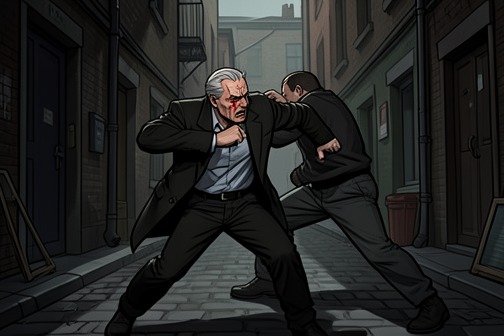
[John Willard](entity:character-recall-character-john-willard-08a14a567020)’s attack on Washington is the moment a long-running threat becomes a face-to-face struggle. Washington survives by defending himself, but the encounter does not end the danger: its aftermath makes clear that Willard may still pursue him, and [Tanna](entity:character-recall-character-tanna-7e2f4be68e90) urges him to leave for [London](entity:location-recall-location-london-420923d4a60a).
## Background and Stakes
Washington’s fear of being seized again had developed during his time in [Nova Scotia](entity:location-recall-location-d59dfadbcba8). There, he had learned that kidnappers roamed the coast and could abduct a free Black man and force him back into slavery. He also experienced hostility from white residents who resented Black workers competing for employment. After a stranger attacked him from behind outside a tavern, Washington escaped by fighting back, but remained unable to shake the feeling that the assailant might have been Willard. The episode made him more watchful and solitary, showing how the threat persisted even when he was not certain who was pursuing him.
The later assault takes place in a dark alley in London. Washington has long regarded science as a possible equalizer, but he has also come to recognize how readily supposedly neutral spaces are shaped by racial prejudice. The violence makes the limits of his safety immediate: he is attacked not in an isolated past but in the city where he has tried to build a new life.
## The Assault
Willard strikes Washington on the forehead, then hits him again as Washington tries to keep his footing. Washington falls and attempts to move out of reach. In the ensuing struggle, Willard grabs his face, and Washington recognizes him. Willard’s words make the encounter personal: he accuses Washington of humiliating and embarrassing him. The stated grievance is not simply that Washington has escaped; Willard treats Washington’s resistance and independence as an affront to his own authority.
The two men struggle on the ground, each trying to overpower the other. Washington remembers the ivory-handled kitchen knife he has been carrying in his pocket. Unable to free both hands from Willard, he gradually works one loose, draws the knife, and strikes beneath Willard’s spectacles. The blow gives Washington enough space to push him away and escape. He leaves injured and shaken, but alive; the assault ends with Willard still living rather than dead.
## Aftermath and Consequences
Washington later recounts the attack to Tanna, who recognizes that it was not a random assault: she suspects John Willard or one of his agents. Washington confirms that Willard survived. The knife had struck at an awkward angle, and Washington believes Willard would probably lose an eye, but he does not think the wound was fatal. His account also makes the distinction between defending himself and killing his pursuer decisive: accepting that Willard lived brought Washington a measure of relief, because he would not have become the murderer he had feared he might be.
Tanna does not accept Washington’s claim that the danger is over. She urges him to leave for London at once, warning that Willard will find him and arguing that London offers greater protection. The attack thus changes the immediate course of Washington’s life: even after he has fought off Willard, the threat remains active enough to require flight. The violence has ended in the alley, but not the pursuit.
## The Assault’s Moral and Narrative Turn
The encounter brings together two kinds of danger Washington has faced before: the physical threat of being overpowered and the racial authority that treats his freedom as an offense. Earlier, Captain Benedikt had dismissed Washington as property despite [Titch](entity:character-recall-character-titch-aeced6aa1952)’s defense of his scientific skill; in Nova Scotia, Washington had feared kidnappers who could force a free man back into slavery. Willard’s attack makes that vulnerability personal again. His accusation that Washington has humiliated him casts the violence as an attempt to punish Washington’s resistance, not as an unexplained street crime.
Washington’s defense turns on an object carried from his daily work: the ivory-handled kitchen knife he had taken from a sideboard drawer. Unable to release both hands from Willard, he works one free, draws the blade, and strikes beneath Willard’s spectacles. The action stops the assault long enough for Washington to push Willard away and escape, but it does not resolve the threat through death. Later, Washington explains that the knife went in at an awkward angle and that Willard would likely lose an eye, while remaining alive. His relief at this outcome marks a boundary he feared crossing: surviving the struggle matters, but so does not becoming a murderer.
## Consequences and Continuing Threat
When Washington later recounts the assault to Tanna, she identifies the attack as deliberate rather than random and suspects Willard or one of his agents. Washington tells her that Willard survived: the knife had entered at an awkward angle, and he expected Willard to lose an eye, not his life. That distinction matters to Washington. Knowing that he had stopped the attack without killing his pursuer gives him some relief; he had feared becoming a murderer himself.
Tanna rejects Washington’s belief that the danger has passed. She insists that he leave for London, where he will have greater protection, because Willard may still find him. The encounter therefore ends the immediate assault but not the pursuit. Its aftermath turns a moment of self-defense into a renewed flight, while Washington’s survival depends on holding together two necessities: resisting the violence directed at him and refusing to let that resistance become a killing.
Event 20
Washington discovers Big Kit is his mother
[Washington discovers Big Kit is his mother](entity:event-recall-event-3a9b34ba23bb) while searching the [Faith Plantation records](entity:object-recall-object-faith-plantation-recor-04dfa67aa232) with [Tanna](entity:character-recall-character-tanna-7e2f4be68e90). The revelation comes through two starkly different forms of evidence: a death date in a workers’ register and her name in a ledger kept by Richard Black, Washington’s former master. The records confirm both a loss he had long suspected and a kinship [Big Kit](entity:character-recall-character-big-kit-7bc19d4cb80d) never disclosed; Washington’s memories then give emotional meaning to the identity the archive can only state.
## The search in the plantation records
Years after leaving [Barbados](entity:location-recall-location-barbados-a285bae3d98a), Washington returns to the history of [Faith](entity:location-recall-location-faith-a5239fbf2174) through its surviving documents. The search takes place in a small room where old volumes and a scrapbook of newspaper notices have been laid out for him and Tanna. The records are not neutral keepsakes: they catalogue plantation workers, sales, deaths, and the institution that treated enslaved people as property. Their pages preserve evidence, but their categories also bear the marks of the system that produced them.
Before the discovery about his mother, Washington finds the reward notice that he and [Titch](entity:character-recall-character-titch-aeced6aa1952) had seen in Virginia. It identifies him as a fugitive slave, describes his facial burns, and names [John Francis Willard](entity:character-recall-character-john-francis-willar-1d32f7b6a676) as the agent acting for [Erasmus Wilde](entity:character-recall-character-erasmus-wilde-686fae23fb63). The notice makes the archive’s reach personal: it has preserved not only plantation administration but the language of a pursuit that continued beyond Faith. The discovery of Big Kit’s identity follows within the same search, connecting the records of Washington’s escape to the family history that had remained unknown to him.
## A death date, then a name
The first crucial record is a register of apprentices who continued working on the plantation after Emancipation. It lists names alongside death dates. Washington already carries a grim certainty that Big Kit is dead, but seeing her death entered in the register makes that knowledge official and immediate. He searches for her under both the name he knew, Kit, and the name he understands to be her birth name, Nawi, before finding the death date recorded in a fine hand.
The form of the entry intensifies the loss. The register sets a person’s death among orderly columns, as though it were comparable to stored goods or sugar yields. Washington imagines that Big Kit’s body may have been removed from the fields with little ceremony. The record tells him that she died; its impersonal format cannot convey the labor, attachment, or individual history that the entry has reduced to a name and date.
A second book supplies the answer the first cannot. This ledger is carefully kept in the handwriting of Richard Black, Washington’s first master. On its marked page, Washington reads the name Catherine MacCauley and then the familiar name Kit. He understands that Big Kit had been his mother. The revelation is not an inference drawn from resemblance or rumor: it is the relationship disclosed by the names preserved in the plantation ledger.
## Memory recast as a mother’s care
The archival identification changes the meaning of Washington’s memories without making them simpler. Big Kit had ignored him for years, then, after he appeared in her hut, defended him fiercely against those who might hurt him. Her care could be protective and frightening: she cursed him, struck him, and held him with a force that could hurt. She also mocked his questions about his parents with extravagant, contradictory stories, at times insisting he had been born of animals or natural forces, and at other times telling him that his mind was brilliant and unmatched.
Washington now reads that unruly mixture of taunting, tenderness, and severity as a mother’s love shaped by the threat of separation. Big Kit had lost much in her life, and her attachment to him carried the fear that he, too, would be taken away. Her fierce defense of him is therefore more than a striking episode from his childhood: after the discovery, it becomes the action of a mother trying not to lose her child again. Yet the records cannot explain why she concealed their relationship, and the scene offers no conversation in which Washington can ask her. The knowledge arrives only after her death.
## The absent history behind the entry
The discovery also opens onto a history Washington can only imagine. Big Kit had been born in Africa and transported across the Atlantic into slavery. He pictures her capture, her journey to the coast, the violence of the slave fort, and the crossing to Barbados. These passages are presented as Washington’s inward reconstruction, not as testimony recovered from the ledger. His recognition of what the records omit becomes part of the event: the archive supplies a name and a death date, while the scale and particulars of Big Kit’s life remain beyond its account.
That gap is especially painful because Washington remembers having left her behind when he chose to accompany Titch. Over time, he had begun to forget her face and voice. The ledger restores the fact of their relationship, but it also confronts him with the years and experiences that cannot be recovered. When Tanna places a warm hand on his shoulder, Washington realizes that he is crying. The intimate gesture meets a grief that the written record has brought into the room but cannot console.
## Significance
The event joins personal recognition to a critique of plantation recordkeeping. Richard Black’s ledger preserves the identity that makes Washington’s relationship to Big Kit legible, while the apprenticeship register records her death in the impersonal language of labor management. The same archive that allows Washington to find his mother also exposes how enslaved people and their descendants were made to appear as entries in an administrative system.
Because the discovery occurs through documents, it does not restore the possibility of reunion or return Big Kit’s own account of her life. Instead, it forces Washington to read the evidence against the narrow terms in which it was recorded, setting names and dates beside remembered acts of protection and care. His mother’s identity becomes certain at the very moment her personal history remains irretrievably incomplete: the revelation gives their bond a name, but arrives too late for the people it connects to speak together.
Event 21
华盛顿在格兰伯恩得知蒂奇仍然活着
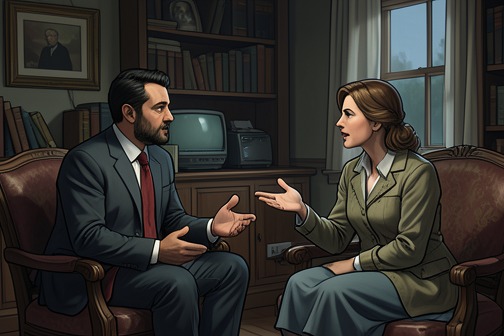
Washington and [Tanna](entity:character-recall-character-tanna-7e2f4be68e90)’s visit to [Granbourne](entity:location-recall-location-granbourne-b0c4f3a26ab8) turns an uncertain search for [Titch](entity:character-recall-character-titch-aeced6aa1952) into the discovery that he survived the years since his disappearance. Mrs. Wilde says she has not seen her son for three years, and a manservant later dates his last known visit to roughly two years earlier. His account links Titch to [London](entity:location-recall-location-london-420923d4a60a), the Anti-[Slavery](entity:state-recall-state-slavery-f0dd6fe31d7a) Society, and the papers from [Faith Plantation](entity:location-recall-location-faith-plantation-022a324e99e0), giving the search a new lead without resolving where Titch has gone.
## The search at Granbourne
Washington and Tanna arrive at the Wilde home and ask whether Christopher Wilde is there. Tanna puts the question to Mrs. Wilde after the two visitors have been received at the house; her brief inquiry is met with an answer that initially leaves the identity of the absent Wilde unclear. Mrs. Wilde says she has not seen her son for three years. For Washington, the interval itself is decisive: the news establishes that Titch lived beyond the separation that had left his fate uncertain.
## Confirmation and uncertainty
Washington reads Mrs. Wilde’s answer alongside [John Willard](entity:character-recall-character-john-willard-08a14a567020)’s earlier account and recognizes that Titch survived. He pictures him leaving through the snow into an open life, but the information is not a report of a reunion or even a full account of what followed. Mrs. Wilde offers no destination, and the years without contact remain unexplained. The meeting therefore shifts Washington’s understanding without giving him the certainty he wants: Titch is alive, but still absent.
## The manservant’s account
A frail manservant provides the more useful history. He says Christopher was at Granbourne some two years earlier, or less, and left upset. He adds that relations between Mrs. Wilde and her sons had often been troubled, though he does not know what distressed Titch on that occasion. His account gives the visit an emotional context while keeping its cause unknown.
The manservant also recalls that Titch was closely involved with the Anti-Slavery Society, frequently attending its offices and seeking ways to assist. After [Erasmus Wilde](entity:character-recall-character-erasmus-wilde-686fae23fb63)’s death, Titch had placed the plantation papers there; he then went regularly to help sort them. The servant cannot confirm whether Titch managed to sail from [Liverpool](entity:location-recall-location-4add46a5f15a) on the Society’s behalf, and says Titch himself had seemed apprehensive about doing so. What he can confirm is that Titch did not return to Granbourne and was not heard from again there. He directs Washington and Tanna to inquire at the Society’s offices, turning recollection into a practical next step.
## What the discovery changes
The news unsettles Washington’s picture of Titch. After hearing that Titch had been seen mumbling in the street, Washington had partly imagined him as half-mad; the servant’s account instead describes someone capable of placing [Faith](entity:location-recall-location-faith-a5239fbf2174)’s records securely and spending his time helping the Society sort them. Titch’s work with those documents also connects his departure to the history of the plantation and to the aftermath of [Erasmus](entity:character-recall-character-erasmus-1b3a48b98972)’s death, even though the precise purpose and outcome of his intended voyage remain unknown.
The episode ends not with Titch found, but with a route toward finding him. Mrs. Wilde establishes survival; the servant supplies the London lead and identifies the Anti-Slavery Society as the place to pursue it. The distinction matters: Washington’s dread of permanent loss gives way to a possibility of renewed contact, while the unresolved gap between Titch’s last recorded visit and his disappearance keeps the search open. The discovery begins a further stage of the pursuit rather than closing the separation.
Event 22
新门监狱的公开绞刑
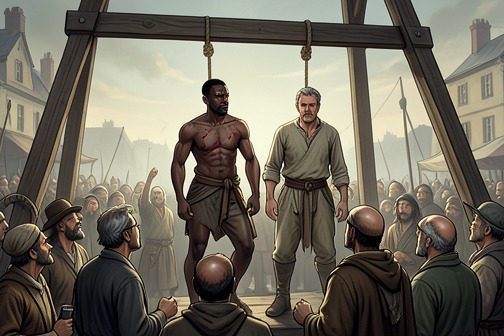
The Newgate public hanging is the closing scene of Washington Black’s long conflict with [John Francis Willard](entity:character-recall-character-john-francis-willar-1d32f7b6a676). In the presence of a large crowd, Washington watches Willard and Louis Hazzard led to the scaffold and executed. Willard’s death ends the immediate pursuit, but the scene also unsettles Washington’s judgment of his own past: the man he had spared is now dying by law, and the apparent resolution exposes the unequal conditions beneath the spectacle.
## Background and Stakes
Washington and [Tanna](entity:character-recall-character-tanna-7e2f4be68e90) decide to attend because he cannot accept Willard’s death without seeing it. The newspaper reports that two men are to be hanged: Hazzard, a Black man convicted of theft and arson, and Willard, a Scotsman convicted of murdering a free man. Washington wonders whether Willard killed another man while pursuing what he believed was Washington, or whether he attacked a Black man at random. The execution thus gathers together the fugitive history that has shaped Washington’s life and the violence that Willard continued to enact after Washington escaped.
The event also answers a question planted by the discovery of the old plantation records. There, Washington found the thousand-pound reward notice identifying him by his burns and naming Willard as the agent acting for [Erasmus Wilde](entity:character-recall-character-erasmus-wilde-686fae23fb63). The notice had reduced Washington to a description of a fugitive slave and advertised the prospect of taking him dead or alive. At Newgate, the pursuer himself is placed under sentence and brought before a crowd, a reversal that does not erase the violence of the system that made Washington’s freedom precarious.
## The Journey to Newgate
The hanging takes place on Wednesday, after Washington and Tanna reach their decision over a meal of cold mince and pickled smelts. They travel in silence, and Tanna removes her gloves to hold Washington’s damp hand. They hear the crowd before they see the prison. It is so large that they leave the carriage before reaching the gates and make their way on foot through the rain-damp streets.
Washington estimates that at least four hundred people have gathered. He forces a path through them, using his height and broad shoulders to get himself and Tanna closer. The crowd includes sailors, former enslaved people, poor women, and children moving among the adults. In seven months in [London](entity:location-recall-location-london-420923d4a60a), Washington has not previously gone to Newgate. Now he sees a tall brick prison, a temporary platform with a gallows, and a low fence that barely separates the spectators from the place of execution. The arrangement makes punishment public: the prisoners are displayed to a mass audience, while the fence marks a fragile boundary between those watching and those about to die.
As they approach, Washington becomes increasingly anxious and nauseated. He understands the scene as the possible end of the drama that has occupied the last five years of his life. He also worries that he should not have brought Tanna. Her presence matters throughout the episode: she holds his hand during the journey and grips his arm as Willard appears, while Washington later draws her face against his chest to shield her from the execution.
## The Execution
At noon, the two prisoners are brought out. Hazzard appears first. Washington does not recognize him, but the sight makes him start, as though confronted with someone familiar. Willard follows. Washington recognizes his damaged, sightless eye behind his spectacles, his prison shirt, and his blond head. Willard stands upright and looks over the crowd as if searching for someone, visibly exhausted.
The sight changes Washington’s understanding of the earlier encounter in [Nova Scotia](entity:location-recall-location-d59dfadbcba8), when he did not kill Willard. He had regarded his refusal to take a life as evidence of decency. At Newgate, seeing Willard face execution, he recognizes fear as part of what had restrained him. He also considers the possibility that Willard’s pursuit had been driven by a desire to die at Washington’s hands, making Washington’s earlier decision more morally complicated than he had allowed himself to believe. The execution does not prove that interpretation; it brings Washington’s uncertainty and self-questioning into focus.
The hanging proceeds without ceremony. The hangman positions the prisoners beneath the beam, places nooses around their necks, and covers their heads. A preacher speaks, but Washington cannot hear his words. As the crowd jeers, the hangman releases the platform. The men struggle briefly, then become still. The hangman checks each prisoner’s death before leaving the scaffold. Washington draws Tanna close so that she will not have to watch the final moments.
## Public Punishment and Aftermath
The spectators’ response makes the execution more than a private ending to Washington’s pursuit. Once the prisoners are dead, the crowd cheers, laughs, and sings; then attention turns back to the gathering itself, where fights break out as a nearby guard remains indifferent. The event functions as public entertainment as well as legal punishment. The law’s display places two condemned men on the same scaffold, but their stated crimes and the racial context are not interchangeable: Hazzard is a Black man condemned for theft and arson, while Willard is a white Scotsman convicted of killing a free man.
Washington’s final response is that the matter is over. Yet the ending does not make the scene emotionally simple. He stands among the crowd, sees Tanna looking grimly toward the bodies, and feels irritation at her attention even as he recognizes that her fascination is understandable. Beyond her, he notices a tall, slightly corpulent man watching the gallows, holding and turning a black top hat. That unresolved glimpse leaves the scene’s last moment with an observer whose presence Washington registers but does not explain.
## Narrative Significance
The episode is narrated retrospectively by Washington, whose account has already marked the uncertainties surrounding his own beginnings and the limits of what he can know from memory. Here, his close attention to Willard’s appearance is joined to a revision of his own moral story: the belief that he had spared Willard from principled mercy gives way to the more troubling possibility that fear also shaped his choice. The public execution therefore closes the pursuit without offering a clean moral victory.
Newgate’s scaffold also contrasts with the plantation’s more direct control over enslaved people’s bodies and lives. At [Faith Plantation](entity:location-recall-location-faith-plantation-022a324e99e0), punishment was imposed by the master and overseers; in London, death is delivered through a public legal procedure before a crowd. Both scenes expose power over the vulnerable, but the ceremony and crowd at Newgate make that power visible as spectacle. By setting Willard’s execution beside Hazzard’s, the novel shows that a shared scaffold does not dissolve the distinctions of race and status that organize the wider story.
Event 23
Washington finds Peter Haas in Amsterdam
Washington’s meeting with [Peter Haas](entity:character-recall-character-peter-haas-6c6602179b97) in [Amsterdam](entity:location-recall-location-ff526395fd98) turns a search for [Titch](entity:character-recall-character-titch-aeced6aa1952) into a second, uncertain pursuit. Peter confirms that Titch survived the Arctic and had visited him, but he is gone again; the encounter offers Washington not the reunion he sought, but a destination, a device, and renewed reason to travel.
## Arrival and Recognition
Peter’s appearance makes the northern past suddenly present. His eyes are stark grey, his thin hands marked by dark veins, and the brown moles on his pale face are the same ones Washington remembers from the cold plains. When Peter embraces him, the old man’s hold is weak, his clothes smell of wet wool, and the contact carries Washington back to the snow and its obliterating whiteness. Recognition here is bodily as much as visual: the familiar face collapses the distance between Amsterdam and the Arctic.
Peter does not speak aloud. He signs with urgent movements, while his son voices his words in a thick Dutch accent: Washington has survived. The mediation unsettles Washington, who hears Peter’s meaning coming from across the room through another person’s voice. The scene thus makes reunion inseparable from change: Peter is recognizable, yet his means of communicating have altered, and the younger Haas now stands between father and visitor as interpreter.
## News of Titch
The meeting does not produce the long-awaited reunion with Titch. Peter explains that he came to Amsterdam about a year and a half earlier and stayed for several weeks, but has since gone. The absence is sharpened by the failed correspondence: Peter says he received no letters and finds it strange that they should all have gone astray. Neither side can explain their disappearance, leaving the lost messages as a practical and emotional gap between the men.
Washington asks specifically where Titch went in the snow on the day he disappeared and how he survived. Peter says they finally discussed it during Titch’s visit, but the recollection does not provide a complete account of the Arctic disappearance. Instead, it leads to Titch’s later preoccupation: he had become absorbed in capturing images on paper, speaking about sunlight burning faces onto paper and calling the results shadow grams. Peter found the ideas frenzied and not entirely intelligible, and thought Titch exhausted. The explanation gives Washington evidence of Titch’s continuing scientific fixation without resolving what happened to him or why he left.
Peter’s latest letter places Titch in [Morocco](entity:location-recall-location-c725843469a0), on the outskirts of [Marrakesh](entity:location-recall-location-52da049d2f78). It had arrived some eight weeks earlier, and Peter believes Titch may still be there because he had calculated carefully where the project should be undertaken. The destination is concrete, but the prospect remains uncertain: Peter cannot promise that Titch is in a state of mind to reply, and Washington and [Tanna](entity:character-recall-character-tanna-7e2f4be68e90) initially say they are not going to Morocco.
## The Instrument and the Unfinished Search
Peter nevertheless gives Washington a large wooden case, asking him to take it if he seeks Titch. He says it might help with the work, though he only partly understood Titch’s plans. Washington resists, pointing out that they have no intention of going to Morocco and suggesting that Peter keep it. Peter insists that the instrument would be wasted in his own care, and that his son is no man of science. The case turns Peter’s account into a tangible handoff: the visit does not reunite Washington and Titch, but leaves Washington holding an object meant for the absent man.
The event therefore advances the search by stages rather than completing it. Peter confirms that Titch survived the Arctic, establishes that he later returned to Amsterdam, and supplies Morocco as his last known destination. At the same time, lost letters and Peter’s uncertain grasp of Titch’s plans preserve substantial gaps. The instrument carries those gaps forward, making the next encounter possible without guaranteeing it.
## Narrative Significance
The Amsterdam episode binds survival to absence. Peter’s body and his recollections give Washington a living connection to the northern ordeal, but the man he most wants to find has already passed through and disappeared again. The repeated movement from recognition to missing information keeps the search unresolved: Washington finds one survivor, learns that another has left, and receives only a provisional lead.
The exchange also brings communication and observation into focus. Peter’s son gives voice to his father’s signs, lost letters have failed to connect the characters, and Titch’s image-making project is reported secondhand as a difficult-to-follow pursuit of light and faces. The wooden case, entrusted to Washington despite his refusal, becomes the scene’s most concrete promise: a means of carrying knowledge toward Titch even when his whereabouts and intentions remain uncertain.
Event 24
Washington reunites with Titch in Morocco
[Washington reunites with Titch in Morocco](entity:event-recall-event-58a10763f228) after four years apart, but the encounter is no simple restoration of their former closeness. A guide who had once been expected to lead Washington and [Tanna](entity:character-recall-character-tanna-7e2f4be68e90) to [Titch](entity:character-recall-character-titch-aeced6aa1952) finds them by chance in [Marrakesh](entity:location-recall-location-52da049d2f78), takes them into the desert, and brings them at last to a remote courtyard. There, the familiar face appears altered by pain; recognition arrives in a cry, and reunion in a quiet remark, while Washington still cannot bring himself to embrace his old companion.
## The Unexpected Guide
Washington and Tanna are in Marrakesh when a slight, angular man approaches and asks whether he is Washington Black. The man’s broken English and flattened vowels make the question distinctive, but the greater surprise is his identity: he is the very person who had been meant to lead them to Titch earlier. He explains that illness had prevented him from coming; recovered, he had entered the city with only a dim hope of finding them. Their meeting is therefore less the result of a reliable plan than of a delayed coincidence that finally reconnects the search party with its intended guide.
The guide leads Washington and Tanna away from Marrakesh in a small, rattling caravan. The paths through the desert are vast and twisted, and the city’s noise recedes as the travelers feel themselves diminishing in the heat and light. Washington’s body registers the strain: his eyes itch, his lower lip cracks and bleeds, and he holds a damp cloth over his nose to breathe. Even after finding the guide, he is again being carried into unfamiliar country through circumstances he has not chosen.
## Arrival at the Desert Compound
The journey offers little reassurance. Tanna’s blue shawl covers her head and face, conversation dwindles, and Washington grows increasingly certain that they are lost. The landscape seems to distort direction and perception: sounds appear to come from the wrong quarters, the heat presses in and then drops away, and night falls with startling speed. When buildings emerge, they seem at first too much like the shelter he wants to see to be trusted as real.
The travelers reach not the town Peter had described but a few scattered dwellings at the desert’s edge. Their surroundings convey distance from the city and uncertainty about what awaits them. A boy, no more than nine, steps from a courtyard. The guide calls to him sharply; a plaintive but tender exchange follows, and some understanding is reached. The boy gestures for Washington and Tanna to follow, while the guide’s nod confirms that the journey has arrived at its next stage.
Inside the courtyard, the atmosphere changes: it is cooler and stiller, with the smell of boiled peppers and clean fabric. A huge object covered by a tarp occupies the swept stone yard, but Washington cannot make out what lies beneath it. The scene holds recognition in suspense. A man crosses the courtyard carrying a live hen, apparently preparing to kill it for supper; the ordinary act of handling the bird becomes the occasion on which Washington finally sees Titch.
## Recognition and Distance
Washington recognizes Titch before he fully understands what he is seeing. Pain passes through his body, and he calls Titch’s name. Titch turns in surprise and releases the hen, which flaps across the courtyard and vanishes into shadow. The dropped bird gives the reunion a brief, startled physical punctuation: both men have been caught off guard, and the animal’s sudden escape interrupts the expected routines of arrival and supper.
Titch watches the hen for a moment, breathing hard. Then he calls back that Washington is late for supper. The line treats the extraordinary return as if it were an ordinary domestic delay, a familiar welcome offered without explanation. Yet Washington steps forward and sees that Titch is trembling. The relaxed wording and the visible tremor sit uneasily together, suggesting that the meeting carries more feeling than either man can readily put into words.
When Washington sees Titch more fully, familiarity and change coexist. Titch still has bright green eyes and the white scar running from either side of his mouth; he wears wrinkled white linen and pale trousers. But his face seems older, and concentrated pain in his gaze makes Washington momentarily fear that they have come to the wrong place. Washington reads in him the effects of the four years since his disappearance and the darkness Titch seems to have come to understand. The reunion confirms that Titch is alive, but not that he has returned unchanged.
## The Reunion’s Unfinished Welcome
Titch tells Washington that he dreamed Washington would come and remarks on how grown he is. After what feels to Washington like a lifetime of being lost to each other, the words strike him as almost empty. He wants to embrace Titch, but holds back, unable to close the warm, dim distance between them. The physical reunion is thus real but incomplete: they have found one another, yet the intimacy Washington longs for does not immediately reappear.
The scene closes on this hesitation rather than on a declared reconciliation. Titch’s trembling, Washington’s pain at recognition, and the withheld embrace give the encounter its mixed emotional force. The four-year separation has ended in the factual sense—Titch is present, alive, and speaking to Washington—but the passage leaves their unresolved history and the possibility of renewed trust open. As a turning point in Washington’s search, the reunion exchanges uncertainty about Titch’s whereabouts for the harder knowledge of seeing him again and discovering how much distance remains between them.
Event 25
Washington Black and Titch's reunion
Washington Black and [Titch](entity:character-recall-character-titch-aeced6aa1952)’s reunion in the desert is not a simple restoration of their former closeness: it brings Washington face to face with the unanswered questions of his abandonment and forces Titch to acknowledge how their relationship began. The encounter moves from the unease of seeing one another again to a direct challenge about being chosen, used, and treated as family, while a confession about [Philip](entity:character-recall-character-philip-f89be33d583c) reveals another source of Titch’s remorse.
## The Reunion and Its Unfinished Questions
Titch welcomes Washington’s arrival with astonishment, but Washington notices fear or unease in his eyes. The emotional imbalance is present from the start: Titch is surprised that Washington has come so far, while Washington has travelled with questions that cannot be answered by the fact of reunion alone.
Washington asks what Titch meant when he said he had dreamed of him. The question points toward Titch’s account of the northern camp, where he had spoken as if he had been among the others and able to see them. Washington wants to know where Titch really went after leaving his father’s camp and why the search party never found him. Titch does not answer immediately, and the reunion remains unsettled by the disappearance that preceded it.
## Why Titch Chose Washington
Washington names the moment his questions return to: the first evening, when he and [Big Kit](entity:character-recall-character-big-kit-7bc19d4cb80d) were serving dinner to Titch’s brother. Titch had selected him deliberately, saying that Washington was the right size for the [Cloud-cutter](entity:object-recall-object-cloud-cutter-0127844fa39f). Washington understands the practical reason as ballast, and asks why Titch chose him before they knew one another.
Titch confirms that Washington’s size was indeed the reason for that initial choice; he does not claim that the practical calculation was invented later. He distinguishes it, however, from the reasons he subsequently engaged Washington to help with experiments and befriended him. Washington’s grasp of complex equations, Titch says, was rare. When Washington objects to being called a thing, Titch corrects himself: Washington was a rare person.
Titch then says that he treated Washington as family. The declaration does not settle their history. Washington recognizes both that Titch saved him from certain death and risked his own comfort, family’s love, and reputation in opposing the suffering on which his family’s power depended, and that Titch still had the ability to hurt him. The reunion therefore holds gratitude and injury together rather than allowing one to erase the other.
## Titch’s Account of Philip
Titch also begins to explain what happened in the North by looking further back, to his childhood with [Erasmus](entity:character-recall-character-erasmus-1b3a48b98972) and Philip. He says that the three boys were close, but that he and Erasmus did not regard Philip as their equal because Philip’s family was poorer and his manners less refined. Their teasing, Titch admits, went beyond childish mockery: he and Erasmus locked Philip overnight in a disused room and abandoned him naked during an outing after making him cry.
Titch recounts this history as an admission of shame, not as an excuse. It gives context to the guilt that bears on his account of the North, while showing a pattern he must face: affection and companionship existed alongside humiliation and unequal power. His confession does not make Washington’s questions disappear, but it places the reunion within a broader effort by Titch to explain his past conduct.
## A Gesture Without a Final Resolution
Washington answers Titch’s disclosures by questioning whether anyone can know the full truth of another person’s life or suffering. He adds that a person can at least try not to make that suffering worse. The exchange shifts the conversation from a demand for complete understanding to a more limited responsibility: recognition may remain incomplete, but that does not excuse avoidable harm.
After they fall silent, Washington rises and gently places a hand on Titch’s shoulder. The gesture offers care without declaring the past resolved. Titch later lies down to sleep beside the boy, while Washington remains awake in the dark. The scene ends with proximity, exhaustion, and quiet rather than a full reconciliation; the reunion makes renewed contact possible, but leaves the deepest questions between them open.
Event 26
Philip's suicide at Faith
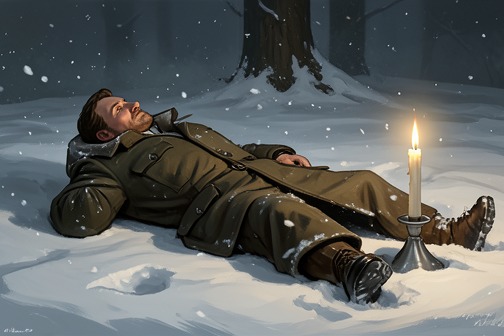
[Philip](entity:character-recall-character-philip-f89be33d583c)’s suicide at [Faith](entity:location-recall-location-faith-a5239fbf2174) is a death Washington Black had witnessed in its aftermath without understanding the history that preceded it. Much later, [Titch](entity:character-recall-character-titch-aeced6aa1952)’s account connects the event to years of cruelty by Titch and [Erasmus](entity:character-recall-character-erasmus-1b3a48b98972) and to Philip’s bereavement over his father. The revelation revises Washington’s understanding of what happened, while opening a contrast between personal guilt and the more pervasive violence of a system that denied enslaved people control over their lives.
## Background and the brothers’ cruelty
Titch describes the three boys—himself, Erasmus, and Philip—as close in childhood, but says that he and Erasmus did not regard Philip as their equal. Philip’s poorer family and less refined manners became material for their teasing. What Titch first presents as childhood mischief grew into a sustained pattern of humiliation and violence: they exploited Philip’s fear of [Granbourne](entity:location-recall-location-granbourne-b0c4f3a26ab8) being haunted, shut him overnight in a disused room, and lured him into the estate woods before ordering him to undress and leaving him to return home alone. Titch acknowledges that he is not proud of their conduct.
The abuse escalated to beatings, with Erasmus especially brutal. Titch recalls that Erasmus continued striking Philip after he had fallen, stopping only when Philip lost consciousness. He says that the two boys had developed a taste for the violence and could not stop. Looking back, Titch wonders whether Erasmus’s later cruelty began with the treatment of Philip. The confession does not establish that as a definitive cause, but it places Erasmus’s violence at Faith within a longer history rather than presenting it as an isolated change.
## The outing before Philip’s father died
Titch identifies a particular night as part of the history surrounding Philip’s suicide. Philip’s father had been ill for weeks, and Philip had stayed by his bedside. Despite his resistance, Titch and Erasmus persuaded him to accompany them to a public house. Philip returned to Grosvenor heavily intoxicated and learned that his father had died. Titch later connects Philip’s suicide at Faith to this history, though his sentence breaks off before he explains the death further.
That interruption matters to the disclosure: Titch names the suicide but does not offer a complete account of its circumstances or a simple explanation. The narrative supports a relationship between Philip’s bereavement, his cousins’ cruelty, and the death at Faith, but leaves the immediate details unstated. Titch’s broken sentence registers the difficulty of telling the story without supplying what he cannot or does not say.
## Washington’s earlier understanding
Washington remembers the night of Philip’s death through its aftermath. He had run to Titch’s study speechless, shaking, and covered in blood; Titch’s silence then had remained with him. Washington had felt responsible for the death despite having had no hand in it, and had been anguished by his inability to stop what had happened. Hearing Titch’s confession causes the remembered events to shift in meaning: Washington can now place Titch’s silence against the older history of mistreatment and the guilt Titch is finally articulating.
The revelation also changes the moral emphasis of Washington’s recollection. His own sense of responsibility had centered on what he could not prevent in the immediate aftermath. He now thinks of his life before Titch arrived: the brutal labor in the fields, the casual possibility that any day could be his last, and the lives of enslaved people that did not belong to them. The account does not equate Philip’s death with the plantation’s system of enslavement; instead, it places Washington’s response to the personal tragedy alongside his recognition of a larger, ongoing deprivation of agency.
## Titch’s account of death and responsibility
After describing Philip’s suicide, Titch recalls being unable to retrieve or touch the body. Confronted with the remains, he felt that the physical body could not contain all that Philip had been. This experience, he says, made him suspect that reality extended beyond its visible physical properties. The moment links his grief to the broader questions about life and the body that emerge in his conversation with Washington, without turning Philip’s death into a fully resolved explanation of Titch’s later choices.
Titch’s confession is therefore both a disclosure about Philip and an admission of his own and Erasmus’s culpability. Washington hears not merely that Philip died at Faith, but that the two men whose childhood relationship he had known as complicated and intimate had helped make Philip’s life grievous long before the final event. The story’s delayed telling allows Washington—and the reader—to revise the remembered scene, while preserving the limits of what Titch actually reveals about the suicide itself.
## Narrative significance
The event is recounted in a later conversation between Washington and Titch, not narrated at the moment it occurred. Its meaning arrives through remembered fragments: Washington’s arrival at Titch’s study, Titch’s earlier silence, the history of Philip’s treatment, and the confession that begins but does not fully explain the death. This structure makes the event a belated revelation rather than a complete reconstruction.
Philip’s suicide also sharpens the distinction between individual remorse and structural violence. Titch can name the harm he and Erasmus inflicted and reconsider its possible connection to Erasmus’s later conduct. Washington, meanwhile, recognizes that his own anguish over Philip belongs beside a history in which enslaved people’s bodies and futures were controlled by others. The death is thus significant not because it resolves either man’s guilt, but because it changes what Washington understands about the past and about the different forms of power that shape a life.
Event 27
Titch's disappearance from the northern camp
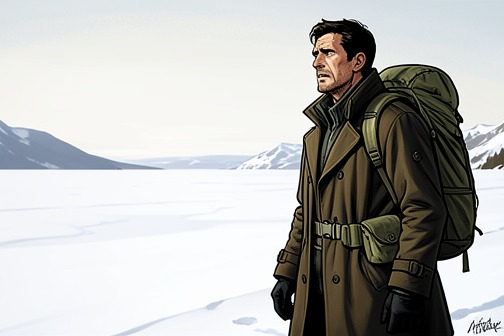
[Titch's disappearance from the northern camp](entity:event-recall-event-titch-cdaef4abded1) leaves Washington Black believing that he has been abandoned in the Arctic, and creates an absence around which Washington's later life and search for [Titch](entity:character-recall-character-titch-aeced6aa1952) take shape. The novel initially tells the episode through Washington's fear and uncertainty; years later, their reunion supplies fragments of an explanation without resolving what Titch did while missing.
## The Search and Washington's Abandonment
After Titch fails to return, searchers go out repeatedly. Titch's father, [Mister Wilde](entity:character-recall-character-mister-wilde-5934725acb51), grows increasingly restless as the days pass: he sleeps little, eats less, and keeps watch at the igloo entrance. Eventually he sets out into the snowy wastes with his survival tools, despite the local people's attempts to discourage him. [Peter House](entity:character-recall-character-peter-house-ada0facbef1f) follows at a distance so that Mister Wilde will not be lost as well. Washington remains at camp, waiting through nights when the searchers return without Titch.
When Mister Wilde comes back without his son, Washington recognizes that Titch is not coming back to him. Mister Wilde offers the quiet reassurance that Washington will manage, but the moment marks a decisive break: Washington understands that he must now ensure his own safety. The disappearance is therefore more than a gap in the search for Titch. For Washington, it is a second abandonment, following the earlier loss of the life he had known before Titch took him away from [Faith Plantation](entity:location-recall-location-faith-plantation-022a324e99e0).
## An Absence That Redirects Washington's Life
The disappearance remains unresolved after Washington leaves the Arctic. Years later, he describes his life as organized around Titch's absence, despite the richness of what he has experienced since they parted. His sense that the ground beneath him might give way echoes the instability of a life redirected by Titch and then left without explanation. Washington eventually decides that he must find Titch and confront him, not simply learn whether he survived but understand what their bond and its rupture have meant.
His search takes him to [Granbourne](entity:location-recall-location-granbourne-b0c4f3a26ab8), where he expects Titch may have returned to the family home. Later, in [Amsterdam](entity:location-recall-location-ff526395fd98), Washington learns from Peter House's son that Titch visited about a year and a half earlier, stayed for several weeks, and then left. Each report confirms that Titch has been alive at a later point, but none explains the northern disappearance. The delay between the original event and Washington's pursuit makes the disappearance an instance of unresolved loss: no confirmed death or explanation closes it, so uncertainty keeps exerting pressure on the relationship.
## Titch's Partial Explanation
When Washington finally meets Titch again, he asks where Titch went after leaving his father's camp and why the search party never found him. Titch says that he knew Washington would not leave him and that he could not go in a simple way. Pressed on whether the departure was a ruse, Titch insists that he left, but gives no fuller account of where he went. His statements do not settle whether he was concealed nearby, out of reach, or somewhere else; the scene preserves the gap rather than filling it with a definite explanation.
Titch also says that he would not have left Washington without protection because Washington had Peter and Mister Wilde. That claim stands against Washington's lived experience: he had believed himself abandoned and had to reckon with the possibility that no one would look after his safety. The reunion therefore exposes not only missing information about Titch's movements, but a lasting difference between Titch's understanding of what he arranged and Washington's experience of being left behind.
## Memory, Uncertainty, and the Reunion
The later conversation links the disappearance to an earlier account Titch gave Peter House. Washington recalls that Titch had spoken of being among the searchers while also claiming that he could see them. Titch does not clarify this claim when Washington asks where he truly went. Later, when Washington tells him he thought he saw Titch in a crowd and followed him, Titch suggests that perhaps it was his spirit, connecting the encounter to his earlier explanation of his whereabouts in the snow. The suggestion offers no verifiable resolution; it leaves the story poised between an evasive account and an uncanny possibility.
That uncertainty matters because the event is narrated in stages. At the camp, Washington can know only that Titch has not returned and that he may have to survive without him. Much later, Washington's questions bring a few statements from Titch, but not the missing account itself. The disappearance thus remains a defining absence rather than a mystery neatly solved: it propels Washington's search, shapes the confrontation at their reunion, and leaves the extent of Titch's responsibility—and the possibility of reconciliation—unsettled.
Event 28
Wash enters the desert storm
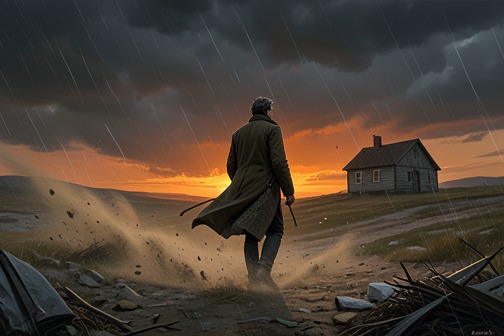
Washington Black enters the desert storm after finding [Titch](entity:character-recall-character-titch-aeced6aa1952) alive in a remote house and spending the night beside him. The act follows years of separation and the return of a painful pattern: Washington fears that a boy left in Titch’s care may one day face the same abandonment he did. As the storm rises, he leaves the shelter and walks toward the orange horizon, with no clear account of what follows.
## Context and the Night Before
The house holds Titch and a boy who is his only companion. Washington recognizes in their situation echoes of his own earlier life with Titch: scattered possessions, instruments that measure without resolving, and the possibility that the boy might someday be left far from where he began. Yet Washington also believes that Titch’s guilt over abandoning him has not occupied Titch’s conscience as Washington once imagined; Titch has suffered other sorrows, and the wounds of his past seem to have fixed him in boyhood.
After Washington gently touches Titch’s shoulder, Titch remains silent, then goes to lie down beside the boy. Washington stays awake in the dark. The wind batters the house, and sand hisses against the windows. A glow gathers beyond the panes, while shadows and sounds make the storm seem to press against the building. The scene places Washington between an intimate, fragile shelter and a landscape becoming increasingly difficult to cross.
## The Storm and Washington’s Departure
As the wind grows more violent, Washington hears it working through the badly nailed boards. He rises, presses his palm against the door, and feels its vibration. He then opens it. The storm has transformed the view outside: yellow air swirls before him, a branch breaks against the stone house, and sprays of sand sweep across the ground. The landscape bears no trace of a person’s passage—not a trail or a footprint.
Washington steps over the threshold. Sand stings and blinds him; he thinks he hears [Tanna](entity:character-recall-character-tanna-7e2f4be68e90) call his name from behind, but does not turn. Instead, he fixes his gaze on the orange blur at the horizon, wraps his arms around himself, and takes several steps forward. The event ends with his departure into the storm, not with a confirmed destination or outcome.
## Consequences and Narrative Significance
The departure is a deliberate crossing from shelter into exposure, but the narration withholds whether Washington is seeking something, escaping something, or simply surrendering to the pull of the horizon. Its immediate consequence is separation from Titch and the boy, who remain inside as Washington leaves. The absence of tracks makes the storm more than a backdrop: it obscures the possibility of return and leaves the ending unresolved.
The scene also reverses the pattern Washington has just identified. He has imagined the boy as a future version of himself, abandoned in an unfamiliar world, yet now Washington is the one who walks away from the house without answering the call he thinks he hears. The narrative does not equate the two departures or explain Washington’s choice; instead, it closes on the tension between his recognition of abandonment and his own movement into uncertainty.